Getting Started
Is Guitar Hard to Learn? A Realistic Beginner Timeline
Is guitar hard to learn? The basics are reachable in weeks. Here's an honest month-by-month timeline so you know what to expect.
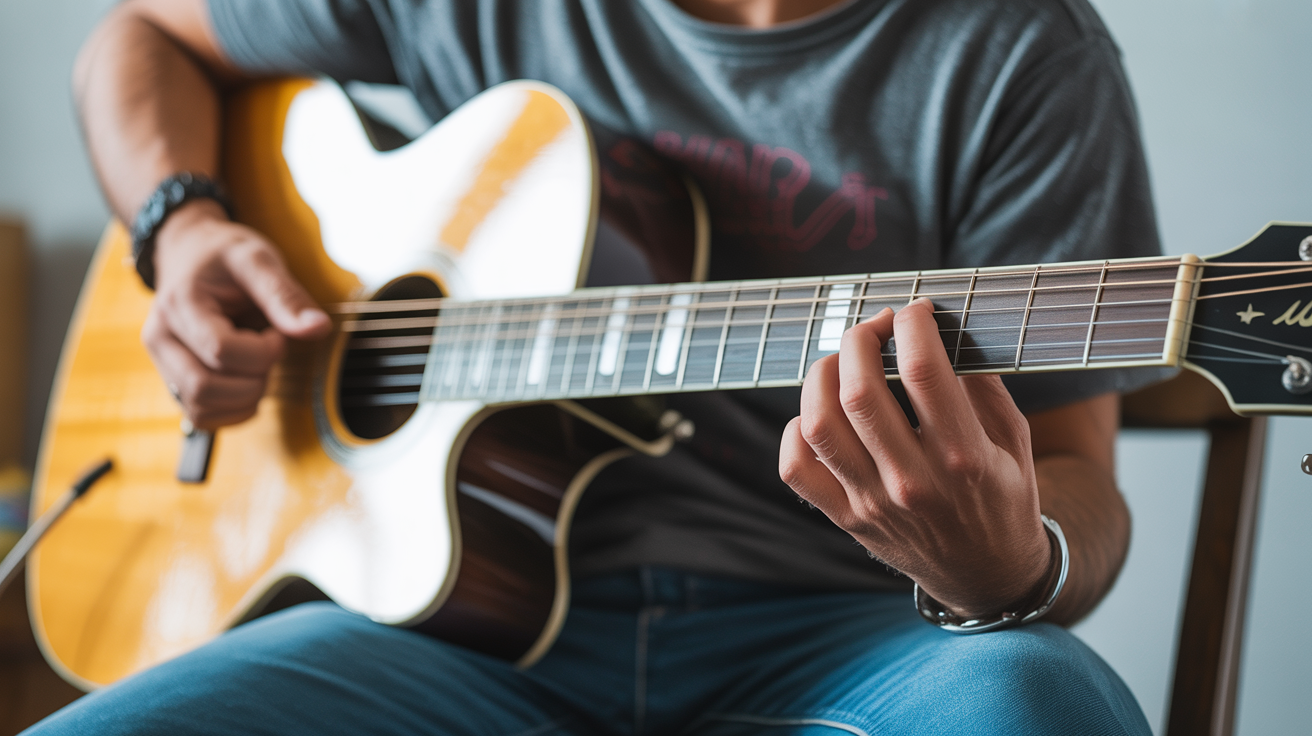
Guitar has a reputation for being difficult, and that reputation puts off more beginners than it should. The honest answer: the basics are reachable in a matter of weeks, and most people can play simple songs within a month. It's not easy, but it's not as hard as people fear, and the early wins come faster than you might expect. What guitar does require is steady, consistent practice, and a clear idea of what to work on first.
What's Actually Hard in the Beginning
The first few weeks feel awkward in ways that are worth knowing about ahead of time.
Your fingertips will hurt. The steel strings on most acoustic guitars press into unconditioned skin, and that stinging sensation is real. It fades after two or three weeks of regular playing as your fingertips build up calluses. Some beginners quit during this window, which is a shame, because it's temporary. Playing through it for 10 to 15 minutes a day is enough to build tolerance without injuring yourself.
Chord shapes feel impossible at first. Forming a clean G chord or an F barre chord requires your fingers to stretch into positions they've never been in. Your ring finger forgets where to go. The chord sounds muted because one finger is accidentally touching the wrong string. This is completely normal. The muscle memory develops gradually, not all at once.
Switching between chords is its own skill. Even if you can hold a G chord and a C chord individually, moving between them cleanly and in time is harder than either one alone. Most beginners underestimate how much of early practice is really about the transitions.
Reading chord diagrams and tabs takes a little getting used to. This isn't complicated, but it adds a layer of decoding on top of the physical challenge. Give yourself a week and it clicks.
None of these hurdles are permanent. They're just the entry cost of the instrument.
A Realistic Month-by-Month Learning Guitar Timeline
Here's what a beginner can reasonably expect, assuming consistent practice of 20 to 30 minutes most days.
| Timeframe | What You Can Expect |
|---|---|
| Week 1–2 | Learn to hold the guitar, understand how to read chord diagrams, form your first 2–3 open chords |
| Week 3–4 | Switch between basic chords slowly, play a simple song with pauses |
| Month 1–3 | Play several songs all the way through, develop a strumming rhythm, start building calluses |
| Month 3–6 | Chord changes feel smoother, add new chords (barre chords begin here), play along with recordings |
| Month 6–12 | Build a small repertoire, start learning solos or fingerpicking patterns, find your style |
Weeks 1 and 2 are mostly about orientation. Where do your fingers go? How do you hold a pick? You're not playing music yet, you're learning the instrument's logic. That's fine.
By the end of month one, most beginners can play a simple song recognizably. It won't sound polished, but it will sound like the song. That's a huge confidence boost.
Months 1 through 3 are where real momentum builds. If you practice consistently during this window, chord changes start to feel less like a puzzle and more like a reflex. You'll also figure out which songs are in your range and which ones to come back to later.
Months 3 through 6 tend to feel like a leveling-up moment. Barre chords (the ones that use your index finger to press all six strings) are the main challenge here. They take longer to master than open chords, and many beginners plateau around them. Push through this and a huge portion of the guitar's chord library opens up.
Months 6 through 12 are about developing a personal approach. Some people lean into strumming and songwriting. Others want to learn scales and lead lines. By this point, you have enough foundation to choose your own direction.
What Makes Learning Guitar Easier or Harder
Several factors genuinely affect how long it takes to get comfortable.
The instrument matters. Classical guitars have wider necks and nylon strings, which are gentler on fingers but harder to grip cleanly for some chord shapes. Electric guitars have thinner strings and lower action, making them easier to press physically. Steel-string acoustic guitars sit in the middle. If you're finding early practice painful or discouraging, picking the right guitar for your hands and goals is worth thinking about before you push through another month of frustration.
Setup makes a big difference. A guitar with high action (meaning the strings sit far from the fretboard) requires significantly more finger pressure. Many cheap beginner guitars come set up poorly from the factory. A basic setup from a local guitar shop, which usually costs $40 to $60, can make the same guitar feel twice as easy to play.
Age is less important than people think. Adults learn differently than children but not necessarily slower. Kids have more flexibility in their hands, but adults typically have better focus and more deliberate practice habits. Adults who start in their 30s, 40s, or later can and do become capable guitarists.
Daily practice beats long weekend sessions. Twenty minutes every day builds neural pathways more effectively than a two-hour session on Saturday. The brain consolidates motor skills during sleep, so short daily practice is actually the efficient choice.
Previous musical experience helps, but isn't required. If you've played piano or any other instrument, concepts like rhythm and timing will feel familiar. If you haven't, you'll just need a few extra weeks to internalize those fundamentals.
If you're just getting going and still figuring out the basics of setup, take a look at our complete beginner's roadmap for starting guitar.
Staying Motivated Through the Slow Patches
Most people who quit guitar do so in the first six weeks. Knowing that in advance is useful.
The biggest motivation trap is comparing yourself to other people. If you're watching YouTube videos of guitarists shredding solos, those guitarists have usually been playing for years or decades. Comparing your week-three self to their week-three-hundred selves isn't fair.
A better approach: compare yourself to your week-one self. Record a short clip of you playing a chord progression in week one, then record the same thing in week four. The improvement will surprise you. Progress is real, just not always obvious from the inside.
Choosing songs you actually like speeds everything up. If you're playing a chord sequence you find boring just because it's "good for beginners," you're fighting yourself. Most popular songs use four or five chords. Find the songs you love, look up the chords, and use those as your practice material.
Finally, take your time choosing a guitar you'll enjoy playing. An instrument that feels right in your hands, has decent tuning stability, and doesn't hurt to play removes a lot of the friction that makes beginners stop.
Frequently Asked Questions
How long does it take to learn guitar as a complete beginner?
Most beginners can play simple songs within four to six weeks of consistent daily practice. Getting comfortable with common open chords and basic strumming typically takes one to three months. Feeling genuinely fluent with the instrument (smooth chord changes, a small repertoire, the ability to learn new songs independently) usually takes six months to a year, depending on how much you practice and what your goals are.
Is guitar harder to learn than piano?
They're different kinds of hard. Piano has a more intuitive layout (the keys go in order, left to right), which makes reading music and understanding theory easier early on. Guitar requires more physical conditioning (calluses, hand strength) and the chord shapes are less visually logical at first. Most people find guitar slightly harder to start but find that the entry point lowers quickly once the basic technique clicks.
Can I learn guitar by myself, or do I need lessons?
Self-teaching works well for many beginners, especially with the quality of online resources available today. Lessons are most helpful in the first few months, where a teacher can correct posture and technique issues before they become ingrained habits. If lessons aren't an option, video tutorials can cover most of the same ground, and a brief "technique check" lesson every few months can fill the gaps.
How many hours a week should a beginner practice?
Fifteen to twenty minutes per day (roughly two hours a week) is enough to make steady progress as a beginner. More practice speeds things up, but quality matters more than quantity. Focused practice on a specific skill, like a single chord transition, is more useful than unfocused noodling for the same amount of time.
Will my fingers stop hurting?
Yes. Fingertip soreness is a real part of the first few weeks, but it's temporary. Calluses form within two to four weeks of regular playing, and once they do, the pain essentially disappears. Playing through the discomfort for short sessions is safe; playing until your fingers are raw is not. Short daily sessions are the most efficient path through this stage.