Getting Started
How to Choose Your First Guitar Without Overspending
Learn how to choose your first guitar with confidence — what to look for, how much to spend, and where to buy without wasting money.
Buying a first guitar feels more complicated than it should be. Walk into any music store and you'll find a wall of instruments spanning $80 to $800, with staff who may or may not point you toward something you actually need. The good news: buying a first guitar doesn't require a music degree or a big budget. A few clear guidelines will get you to the right instrument quickly.
Before anything else, decide what kind of music you want to play. That single question shapes every decision after it, what type of guitar, how much to spend, and where to shop. If you haven't settled on acoustic versus electric yet, take a look at our breakdown of acoustic vs. electric guitar for beginners before reading on.
Budget Ranges and Realistic Expectations
The most common mistake beginners make is spending either too little or too much. Here's what you actually get at each price point:
Under $100: Entry-level guitars at this price often have playability issues straight out of the box, high action (the distance between strings and fretboard), poor intonation, and hardware that won't hold a tune reliably. Some are fine for a child's first strum-around, but if you're serious about learning, this range tends to create frustration rather than progress.
$150–$300: This is the sweet spot for most beginners. Guitars in this range are built by manufacturers who have refined quality control for the student market. You'll get a playable instrument with decent tuning stability and a sound that doesn't embarrass itself. A $200 acoustic or $250 electric can last years and carry you well past the beginner stage.
$300–$500: At this price you're buying real quality, not just beginner quality. The tonewoods are better, the fretwork is more precise, and the hardware holds up. If you already play another instrument and know music will stick for you, this range makes sense. If you're genuinely unsure whether guitar is for you, start lower.
Above $500: Skip it for now. This is the intermediate-to-professional range. Buy here once you've been playing six months and know what you want in an instrument.
One practical note: a $200 guitar that's been properly set up at a shop will play better than a $400 guitar fresh from a warehouse. Setup (adjusting the nut, saddle, truss rod, and action) makes a dramatic difference, worth asking about when you buy.
New vs. Used
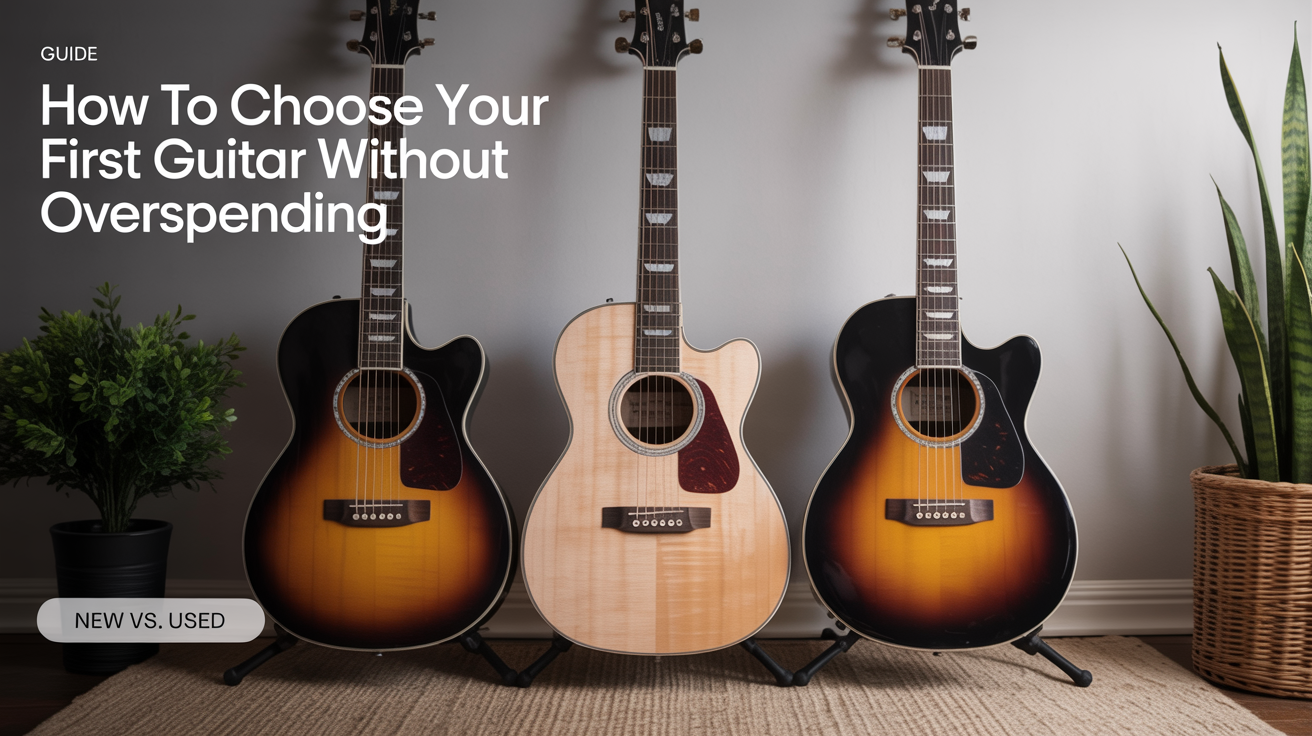
Buying used is genuinely worth considering, especially if your budget is tight. A $300 guitar bought used for $180 is often in better shape than a $180 guitar bought new, because it's already been played in, any warping issues have surfaced, and the previous owner may have had it set up.
Where to find used guitars:
- Local music shops with a used section (they often clean and inspect what they take in)
- Facebook Marketplace and Craigslist (meet somewhere public; inspect it in person)
- Reverb.com (online marketplace specific to musical instruments, with seller ratings)
- Pawn shops (hit or miss, but occasionally excellent deals)
What to check before buying used: Does it tune up and stay in tune? Are any frets buzzing badly? Is the neck straight (sight down it like a pool cue)? Are there cracks in the body or around the headstock? Small cosmetic dings are fine. Cracks in structurally important spots are not.
If you're unsure what you're looking at, bring someone who plays, or ask a shop tech to take a quick look before you commit.
Playability and Action: What Makes a Guitar Easy to Learn On
This is the most underrated factor in the first-guitar decision. A guitar with high action, strings that sit too far from the fretboard, makes fretting notes physically hard and painful. Beginners often quit because they assume their fingers just aren't strong enough, when the real problem is a poorly set-up instrument.
When you pick up any guitar to try it:
- Press down a string at the first fret. Does it take a lot of effort? That's high action.
- Play a chord you know (or have someone play one for you). Do notes ring clearly or buzz and muffle?
- Check the neck. It should have a very slight forward bow (relief), not a dramatic curve or a backbow.
Nylon-string classical guitars have lower string tension, which makes them gentler on fingertips, a reasonable choice for absolute beginners who are worried about finger soreness. Steel-string acoustics are more versatile and ultimately better preparation for most popular music styles. For more on the physical parts involved, our guide to parts of the guitar explains what each component does and why it matters.
Where to Buy and Trying Before You Buy
You have three main options: local music shops, big-box music retailers, and online.
Local music shops are the best starting point. Staff can let you try instruments, answer questions, and often include a free basic setup with purchase. You're also supporting a local business, which tends to mean better ongoing service.
Big-box music retailers (chains with multiple locations and large online presences) stock a huge range and frequently run sales. The staff experience varies, but you can physically handle instruments before buying.
Online is convenient and sometimes cheaper, but you're buying blind. If you go this route, stick to retailers with generous return policies (30+ days, free returns) so you can send it back if the action is unplayable or something doesn't feel right.
The honest advice: try before you buy if at all possible. Even if you've never played, you can tell the difference between a guitar that feels easy to hold and one that's awkward. Sit down, hold it, press a string or two. That immediate physical feedback tells you something.
Beginner Bundles: Convenient but Evaluate Carefully
Many retailers sell "starter packs" that include a guitar plus accessories (tuner, picks, strap, cable, small amp for electric, and sometimes a bag). These can be a good deal, or they can be a way to bundle a mediocre guitar with cheap accessories.
Evaluate bundles by asking: what would I pay for the guitar alone? If the guitar is worth $180 and the bundle costs $220 and includes $60 in accessories you'd buy anyway, that's a reasonable value. If the bundle is $99 and seems to include everything, the guitar is almost certainly the $75 quality instrument you'd want to avoid.
What accessories you actually need on day one:
- A clip-on tuner or tuning app (essential)
- A few picks in different thicknesses (to find what you like)
- A strap (so you can stand and sit comfortably)
- Extra strings (they break)
For electric, add a small practice amp (10–20 watts is plenty) and a cable. You don't need a bag, a capo, a string winder, or a music stand on day one, those come later.
Once you've got the guitar in hand, the next step is figuring out where to start. Our complete beginner's roadmap to playing guitar walks through the first few months of learning so you're not just staring at the instrument wondering what to do next.
Frequently Asked Questions
How much should I spend on my first guitar?
For most adults, $150–$300 gets you a genuinely playable instrument without overspending. Below $100, quality becomes inconsistent. Above $300 is more than you need until you've been playing for a few months and know what you want.
Is it better to start on acoustic or electric?
Neither is objectively better for beginners. Acoustic requires no extra gear (no amp or cable), which keeps startup costs lower. Electric strings are thinner and easier on fingers. The real answer is: start on whichever type plays the music you want to learn. Motivation matters more than the acoustic/electric debate.
Can I learn on a cheap guitar?
You can, but there's a real floor below which cheap becomes counterproductive. A guitar that won't stay in tune or is painful to press down will slow your progress and increase the odds you give up. Spend at least $150 new, or buy used at that quality level. Have it set up at a shop if the action feels high.
Should I buy a guitar bundle or separate pieces?
Bundles can be convenient and occasionally good value, evaluate them by checking what the guitar itself would cost alone. If the math works out in your favor, go for it. If the bundle seems suspiciously cheap, the guitar inside it probably is too.
Do I need a guitar teacher, or can I learn online?
You don't need a teacher to start, but having one (even for a few lessons) can save you from building bad habits that are hard to undo later. Many beginners use a mix of free online resources and occasional in-person lessons. Either path works if you practice consistently.