Chords & Theory
How to Play Power Chords on Electric Guitar
Learn how to play power chords on electric guitar with two simple shapes, proper muting technique, and a beginner-friendly riff to practice.
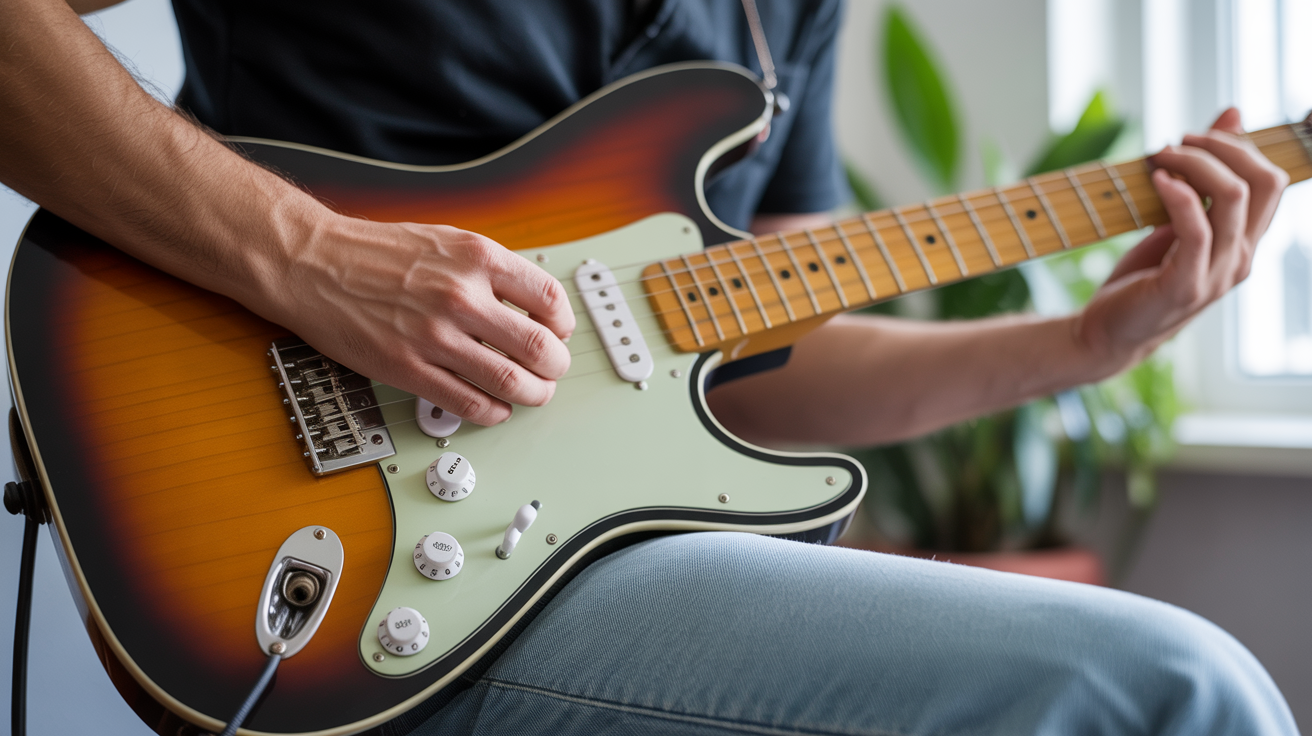
Power chords are one of the first things that make an electric guitar sound the way you imagined it would. Two or three strings, a bit of distortion, and suddenly you have the foundation of rock, punk, and metal. They are also genuinely easy to play, which is a big part of why they show up so early in almost every electric player's journey.
This guide covers what a power chord actually is, the two shapes you need to know, how to mute the strings you are not playing, and a simple riff you can use to practice all of it.
At a Glance
- A power chord uses just the root and the fifth, written with a "5" (E5, A5), with no third at all.
- There are only two shapes to learn: root on the 6th string, and root on the 5th string. The fingering is identical, just shifted down one string.
- Muting the strings you aren't fretting, with the underside of your first finger, is what separates a clean power chord from a noisy one.
- The root note and fifth sit in a 3:2 frequency ratio, which is why the interval stays clean and punchy under heavy distortion instead of turning muddy.
- Both shapes are moveable: learn one fingering, slide it to any fret, and you have a new chord instantly.
- You don't need a pedal to start. The gain channel on a small practice amp is enough to hear the effect.
What a Power Chord Is
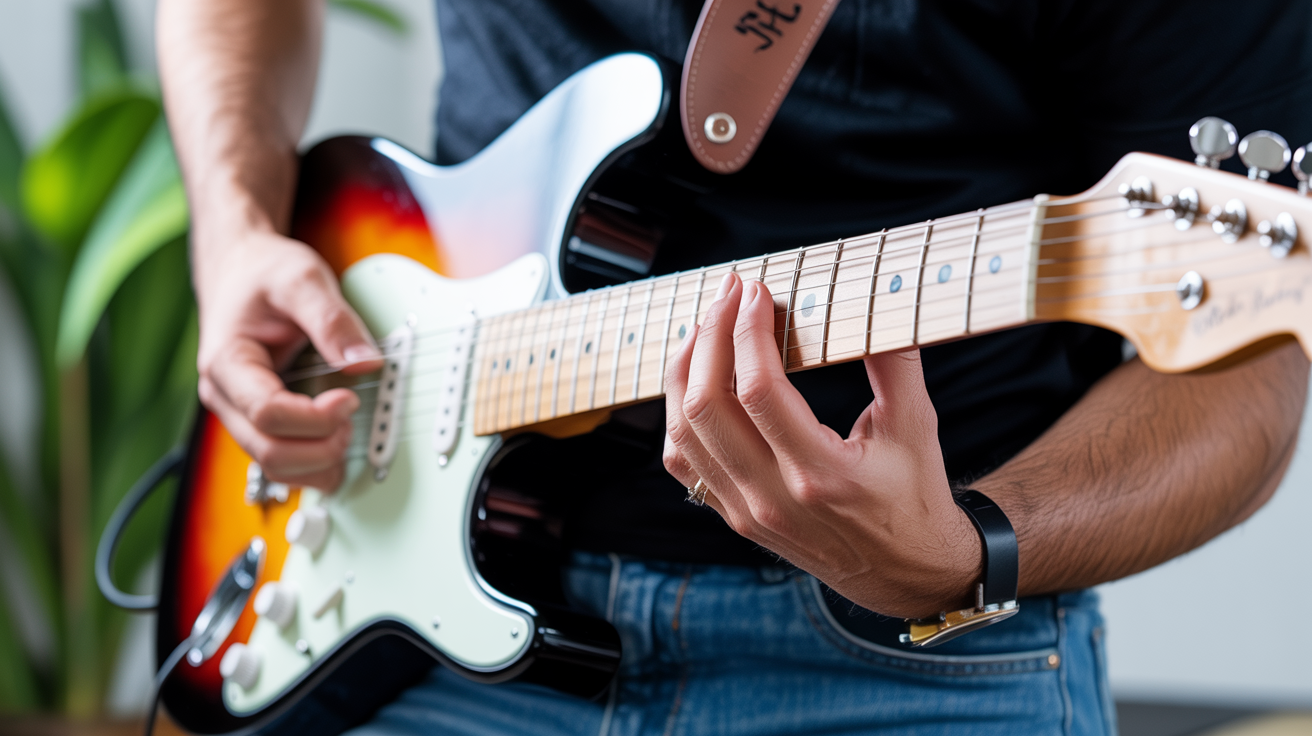
A power chord is built from just two notes: the root and the fifth. On a guitar, that means you press down on a root note on one string and add the fifth on the string below it, two frets higher. Sometimes a third string is added by doubling the root note an octave up, which makes the sound slightly fuller, but the core is always just those two notes. Wikipedia's entry on power chords describes this directly: the chord "consists of the root note and the fifth, as well as possibly octaves of those notes."
The reason power chords sound so good with distortion comes down to that interval. The root and the fifth form a perfect fifth, a frequency ratio of roughly 3:2, one of the simplest and most consonant relationships in music. When you run that interval through an overdrive or distortion pedal, the added harmonics line up closely with the harmonics already present in the two notes, so they reinforce each other instead of clashing. Full open chords like G or D include thirds, and thirds sit at messier ratios that can sound muddy or dissonant under heavy gain. Strip those out, keep the root and the fifth, and the chord stays clean and punchy regardless of how much distortion you add.
Power chords are usually written with a 5 after the note name: E5, A5, G5, D5. That notation signals that the chord contains only the root and fifth with no third at all.
The Two Main Shapes
There are two power chord shapes you need, based on which string holds the root note.
Low E root (6th string)
Place your first finger on the 6th string (the thickest one) at whatever fret gives you the root note. Your ring finger goes two frets higher on the 5th string, one string down. You can also add your pinky on the 4th string directly below your ring finger to get that doubled root.
For an E5, your first finger goes on the open 6th string (or you can barre the nut position), but more practically, try A5: first finger on the 5th fret of the 6th string, ring finger on the 7th fret of the 5th string. That shape can slide to any fret on the low E string.
E5 shape (root on 6th string, 7th fret = B5 as example)
e |---
B |---
G |---
D |---
A |-9-
E |-7-
A string root (5th string)
The shape is identical but moves down one string. First finger on the 5th string at the root fret, ring finger two frets higher on the 4th string, optional pinky on the 3rd string.
A5 shape (root on 5th string)
e |---
B |---
G |---
D |-7-
A |-5-
E |---
Once you have one shape, you have the other. Just shift down a string and the fingering stays the same.
Power Chord Reference: Root Fret to Chord Name
Instead of memorizing the fretboard all at once, use this table for the ten most common power chords beginners actually play, on both root strings.
| Chord | Root fret (6th string) | Root fret (5th string) |
|---|---|---|
| E5 | Open (0) | 7th |
| F5 | 1st | 8th |
| F#5 / Gb5 | 2nd | 9th |
| G5 | 3rd | 10th |
| G#5 / Ab5 | 4th | 11th |
| A5 | 5th | Open (0) |
| A#5 / Bb5 | 6th | 1st |
| B5 | 7th | 2nd |
| C5 | 8th | 3rd |
| D5 | 10th | 5th |
Notice that the same chord shows up in two places, seven frets apart, once on each root string. E5 at the open 6th string and E5 at the 7th fret of the 5th string are the same pitches. Once that pattern clicks, the whole neck stops feeling like a memorization exercise and starts feeling like one repeating shape.
Muting the Strings You Are Not Playing
This is the part beginners most often skip, and it is what separates a clean power chord from a mess of unwanted noise.
The strings above and below your chord need to be silenced. Here is how to handle each:
The strings above your root (higher-pitched strings) are muted by the underside of your fretting hand. When your first finger presses the root note, let the pad of that finger rest gently against the strings below it without pressing them to the fret. Strum across those strings and they should produce a dull thud rather than a ringing note.
The low E string when using an A-root shape is handled the same way. Let the underside of your first finger touch it lightly so it mutes when struck.
Strumming control also helps. When playing power chords live, most players aim their pick at only the strings they need. If you are playing a two-string A-root shape, you aim for the 5th and 4th strings rather than raking across all six. This takes some practice but becomes automatic.
Test your muting by playing the power chord shape, then deliberately strumming all six strings. If you hear anything other than your two or three fretted notes plus dead thuds on the rest, find which string is ringing and adjust your finger contact. A quick diagnostic: strum slowly, string by string, from low to high. The moment you hit a string that rings clearly instead of thudding, that's the exact string your muting finger needs to reach.
A Simple Riff to Practice
Once you have both shapes and your muting is working, try this progression. It covers the low E root shape and the A-root shape and uses three common power chords found in countless punk and rock songs.
Simple power chord riff
Tempo: slow, then up to speed

E5 (6th string, open) - D5 (5th string, 5th fret) - A5 (5th string, open)

e |--------------------------------|
B |--------------------------------|
G |--------------------------------|
D |--2---2---7---7---2---2---------|
A |--2---2---5---5---0---0---------|
E |--0---0-------------------------|

Play each chord as two downstrokes before moving to the next.
Focus on getting a clean stop between each chord rather than playing quickly. The silence between notes is part of the feel. Once you can move between all three without pausing to find the next shape, try adding a simple rhythmic pattern: two down, two down, four down.
This same riff pattern, moved to different frets, gives you hundreds of chord progressions. E5, D5, A5 is one of the most common sequences in rock for good reason. As a practice target, aim to play the full progression cleanly at 80 beats per minute before pushing tempo higher; most beginners can reach that speed within two to three weeks of daily five-minute practice on this riff alone.
Why Power Chords Work for Beginners
Full open chords require pressing four or five strings cleanly at the same time, which means every finger has to land correctly or you get a buzzing note. Power chords reduce that problem to two or three strings and a simple two-finger shape.
The tradeoff is that they work best on electric with some gain. On an acoustic with no distortion, power chords can sound thin or uninteresting. This is not a flaw in the chord. It is just physics: distortion clips the waveform and adds sustain and harmonics that fill out the sound, and a clean acoustic signal has none of that to work with.
If you are still deciding between an electric or acoustic setup, acoustic vs electric guitar: which should a beginner start on covers the practical differences in detail.
Power chords are also a good on-ramp because the shape is moveable. Once you know one power chord, sliding it up or down the neck gives you a new one instantly. This is different from open chords, which each have their own unique fingering pattern. The comparison between open chords vs barre chords goes deeper into how moveable chord shapes work across the neck.
If you want a broader picture of where power chords fit in relation to other chords you will learn, the first 8 guitar chords every beginner should learn puts them in context alongside open chord shapes.
Frequently Asked Questions
Do I need a distortion pedal to play power chords?
No, but they sound much better with gain. A cheap overdrive or the gain channel on a small practice amp is enough. On a completely clean tone, power chords work but can sound hollow. Most beginners start with the gain channel on a small practice amp rather than a separate pedal.
How many strings should a power chord have?
Two or three. The two-string version (root and fifth) is technically complete. The three-string version (root, fifth, and octave root) is slightly fuller and more common in practice. Either is correct.
Why does my power chord buzz or sound muted?
Usually one of two things: your fretting fingers are not pressing firmly enough to the fret, or the pad of a finger is accidentally touching a string it should not. Press closer to the fret (the metal strip, not the wood between them) and check that each fretting finger is angled so only its tip contacts the string.
Can I play power chords on acoustic guitar?
Yes. The shapes work on any guitar. They just sound better on electric with some gain. On acoustic, they are useful for following along with a song or practicing the shapes, but most players do not rely on them as their main acoustic chord vocabulary.
How do I know where to put a power chord on the neck?
The fret position of your first finger determines the chord name. On the low E string, the open string is E, the 2nd fret is F#, the 3rd fret is G, the 5th fret is A, the 7th fret is B, the 8th fret is C. Knowing just these positions gives you enough to play most basic rock progressions without needing to memorize the full fretboard map right away.
Why do some power chords sound "heavier" than others at the same fret?
Thicker strings and lower frets both add low-frequency content, so a power chord rooted on the 6th string at a low fret (like F5 at the 1st fret) reads as heavier than the same chord shape played higher up the neck. Amp settings matter too: more gain and a scooped mid setting emphasize the effect, which is part of why metal tone and punk tone, built from the same power chord shapes, sound so different.