Chords & Theory
Open Chords vs Barre Chords: What's the Difference?
Learn the difference between open chords vs barre chords, when to use each, and how to make the jump to barre chords as a beginner.
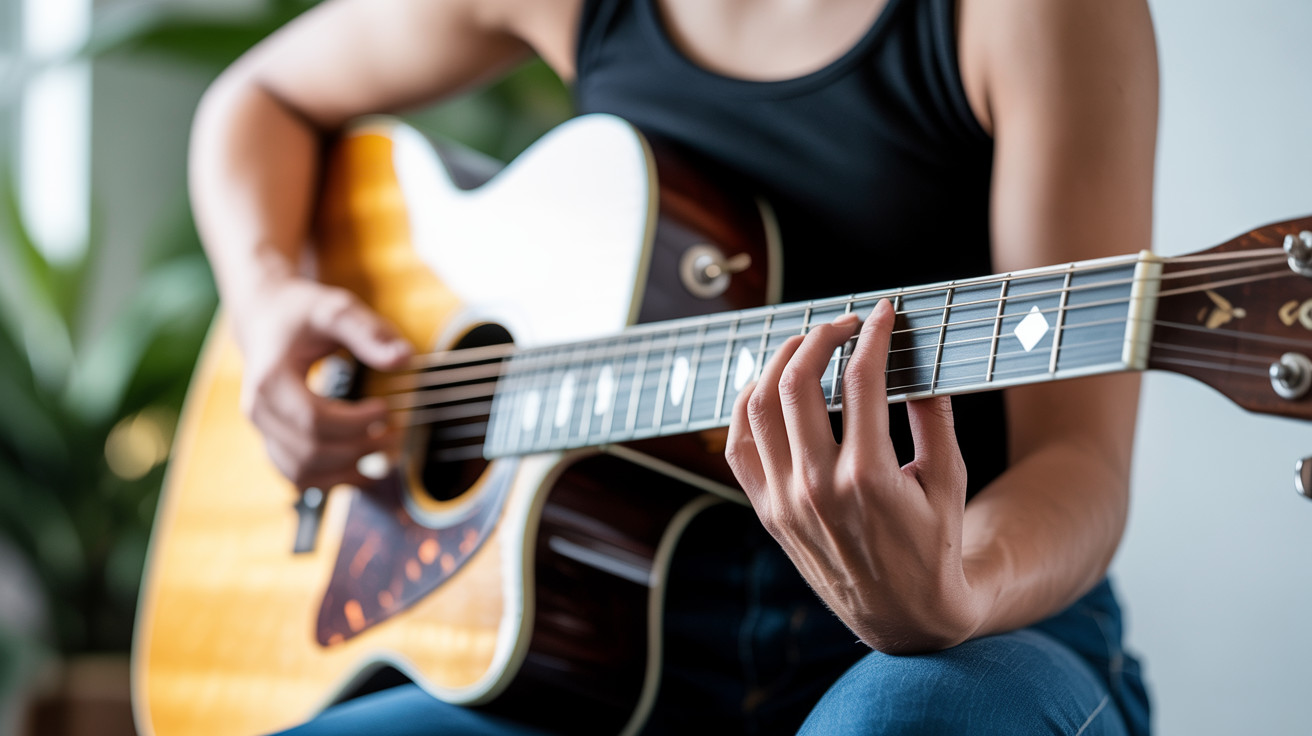
Most beginner guitarists spend their first few months playing open chords, then hit a wall the moment a song calls for an F major or B minor. That wall has a name: barre chords. Understanding what separates these two chord types, and why one is so much harder than the other, will help you plan your practice more honestly and make real progress.
What Are Open Chords (and Why Do They Use Open Strings)?
Open chords, sometimes called open position chords, are chords that include at least one string you don't fret at all. Those unfretted strings ring freely from the nut down, which is why they're called "open" strings.
The classic examples are G major, C major, D major, E minor, A minor, and E major. If you've worked through the first eight guitar chords every beginner should learn, you already know most of them. On a G major chord, for instance, your lowest and highest strings ring open while three fingers cover the 2nd and 3rd frets on the inner strings.
Open chords sit in the first four frets of the neck, close to the headstock. The nut acts almost like a built-in finger, holding the open strings down at zero fret. That's a huge mechanical advantage: you only need two, three, or four fingers to get a full, resonant chord.
Because open strings vibrate freely along their full length, open chords tend to sound bright and ringing, which is partly why acoustic guitar music leans on them so heavily.
What Are Barre Chords and How Does One Shape Move Up the Neck?
A barre chord (sometimes spelled "bar chord") uses your index finger to press across all six strings, or sometimes five, at a single fret. That index finger replaces the nut, creating a movable capo that lets you play the same chord shape anywhere on the neck.
The two shapes you'll encounter first are the E-shape barre chord and the A-shape barre chord.
- E-shape barre chord: Lay your index finger across all six strings at any fret, then form an open E major shape with your remaining fingers just above it. At the 1st fret, you get F major. Slide to the 3rd fret and you get G major. The 5th fret gives you A major. Same four fingers, different fret.
- A-shape barre chord: Same idea, but your index finger barres at the target fret and your remaining fingers form an open A major shape. At the 2nd fret, you get B major. At the 5th fret, C# major. And so on up the neck.
This is what makes barre chords so powerful. One fingering pattern covers every major chord across 12 frets. Add the minor versions of each shape and you can play any minor chord too. The whole fretboard opens up.
Why Barre Chords Are Harder
The honest answer: your index finger has to press six strings cleanly against the frets using only the strength and angle of one joint. That takes time to build.
Two things typically go wrong for beginners:
Buzzing or muted strings. If your index finger isn't pressing directly behind a fret, or if it's slightly bent at a knuckle, one or two strings will buzz or go silent. Getting every string to ring clearly requires both finger strength and precise placement. How to fret cleanly so every string rings out covers the fundamentals that apply here.
Finger fatigue and pain. A full barre at the 1st fret is the hardest position on the guitar because the string tension is highest there. Many teachers recommend starting barre chord practice at the 5th or 7th fret, where the strings are a little closer to the fretboard and easier to press down.
Neither of these problems is permanent. Most players who stick with daily barre chord practice see real improvement within four to six weeks.
When You'll Need Each Type
Open chords and barre chords aren't in competition. They serve different purposes, and almost every song uses a mix of both.
| Situation | What you'll typically use |
|---|---|
| Strumming folk or country songs | Open chords, often all the way through |
| Playing a chord not in the open position | Barre chord (e.g., F#m, Bb, Db) |
| Matching a capo arrangement | Open shapes above the capo |
| Playing rhythm guitar on electric in a band | Barre chords for punch and mobility |
| Fingerpicking with open-string resonance | Open chords for their ringing quality |
| Moving quickly between distant chords | Barre chords (slide the same shape) |
A song in the key of G, for example, might use G, C, and D as open chords and only need a barre for the occasional Em7 or Am variation. A song in the key of F will have you reaching for barre chords almost immediately, since F major itself has no easy open-chord version.
Knowing how to read a chord diagram will help you figure out at a glance whether a chord is open or barred. How to read a guitar chord chart walks you through exactly that.
How to Start Practicing Barre Chords
A few practical steps that actually work:
Start at the 5th fret. Place an A-shape or E-shape barre at the 5th fret and strum slowly. Pick each string individually to hear which ones are ringing. Adjust your index finger position until all six sound clearly, then move the shape down one fret at a time as your strength builds.
Check your thumb. Your fretting hand thumb should sit roughly behind your middle finger on the back of the neck, not hooked over the top. A low thumb gives your fingers more leverage to press down.
Roll your index finger slightly. The soft pad of your finger tends to sit in the groove between strings. Rolling your index finger slightly toward the nut (toward the headstock side) puts the bonier edge of your finger on the strings, which presses them more cleanly.
Practice the chord in isolation before switching. Get a clean barre chord ringing, release, shake out your hand, then press again. Repeat this ten times before worrying about changing from one chord to another. Transitions can come later.
Be patient with the F chord. The open F major barre (E-shape at the 1st fret) is genuinely one of the hardest chords on a standard-tuned acoustic guitar. It's not you; it's physics. Many players learn a simplified F with just two or three strings first, then work up to the full six-string barre.
Frequently Asked Questions
Can I just use open chords forever and skip barre chords?
For some styles, yes. If you mostly play folk songs, country, or singer-songwriter material in beginner-friendly keys, you can go pretty far with open chords and a capo. But barre chords show up in rock, pop, blues, and more, so skipping them entirely limits what you can play.
How long does it take to get clean barre chords?
Most beginners who practice barre chords for 10 to 15 minutes a day start hearing consistent improvement within three to five weeks. A full, buzzing-free barre chord often clicks somewhere between one and three months in, depending on how frequently you practice and the action on your guitar.
Does guitar action affect how hard barre chords are?
Yes, significantly. "Action" refers to the height of the strings above the fretboard. High action means you have to press harder to fret notes cleanly, which makes barre chords much more difficult. If you're struggling despite good technique, ask a guitar teacher or repair shop to check your guitar's setup. A simple truss rod or saddle adjustment can make barre chords noticeably easier.
What's the difference between a barre chord and a partial barre?
A full barre covers all six strings. A partial barre (sometimes called a half-barre) covers only some of them. The B minor chord, for example, often uses a partial barre across the top four strings at the 2nd fret. Partial barres require the same technique but less overall pressure, so they're a good stepping stone.
Should I learn minor barre chords at the same time as major ones?
You can, and it makes sense to pair them. The minor version of an E-shape barre chord (Em shape) and the minor version of an A-shape barre chord (Am shape) use the same index-finger barre as the major versions. Once your barre is solid, switching between major and minor is just a matter of lifting or adding one finger.