Gear & Maintenance
What Is a Capo and How Do You Use One?
Learn what a guitar capo is, how to place it correctly, and when to use one to play songs in any key without learning new chord shapes.
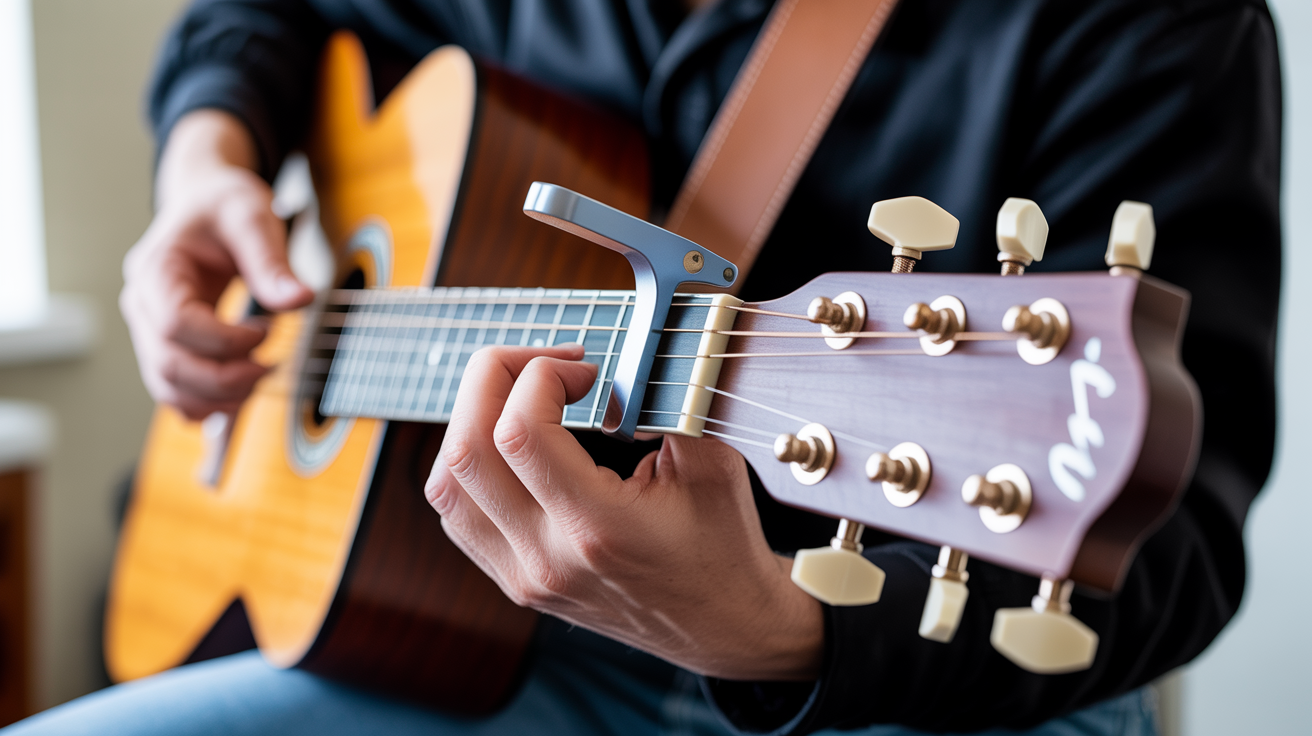
A capo is a small clamp that fastens across all six strings at any fret you choose, raising the pitch of the open strings evenly. Once it's on, you play the same chord shapes you already know, but the guitar sounds higher. That's the whole idea: one inexpensive accessory unlocks hundreds of songs that would otherwise require either a key change or barre chords you haven't learned yet.
At a Glance
- A capo clamps across all six strings at a fret, acting as a movable nut that raises every open string's pitch by the same amount.
- Place it just behind the fret wire, not on top and not centered in the fret space, or you'll get buzzing and muted notes.
- Each fret you move the capo up raises the pitch by one semitone, so fret 2 raises everything a whole step.
- A $10-20 spring-loaded trigger capo is the practical first purchase; it works on both acoustic and electric guitars.
- Always retune after clamping, even on a well-made capo, because the clamping pressure nudges some strings sharp.
- Most beginner tabs already tell you which fret to capo; you don't need to calculate key relationships until you're ready to.
What a Capo Actually Does
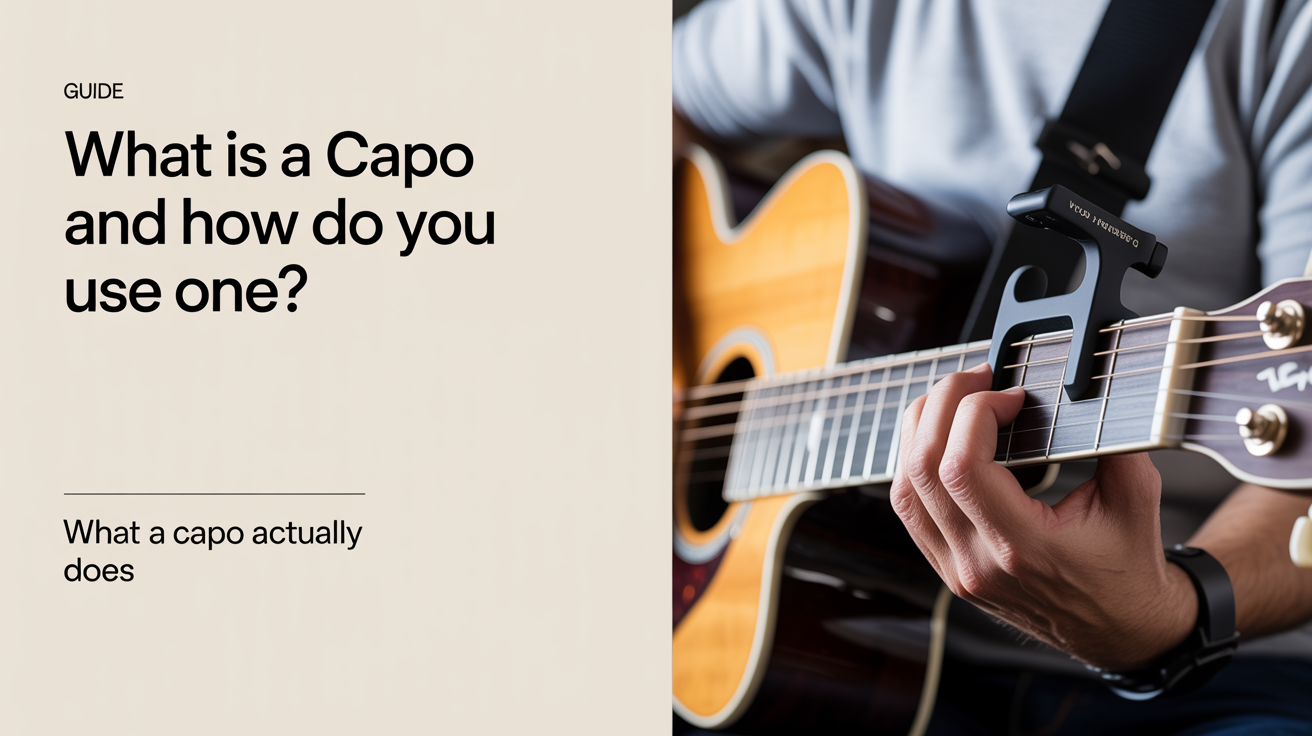
Without a capo, your open strings are tuned E-A-D-G-B-E (low to high). When you press the capo at the second fret, those strings now sound F#-B-E-A-C#-F#. The math doesn't matter much at first. What matters is that every chord shape shifts up by two semitones automatically, and your fingers keep doing exactly what they already know how to do.
Technically, a capo works by creating a new, higher nut at whatever fret you clamp it to. The strings behave exactly as if the guitar were built with a shorter neck starting at that fret, which is why open-position chord shapes still work perfectly above it.
This is why capos appear on beginner gear lists alongside tuners and picks. A tuner keeps your guitar in tune, and a capo lets you stay in tune while playing in whatever key the singer or the original recording calls for.
How to Place a Capo Correctly
Placement matters. A poorly positioned capo causes buzzing, muted notes, or strings that sit out of tune even after you tune up.
Step-by-step placement:
- Pick the fret you need. Count up from the headstock, starting at fret 1 (nearest to the nut).
- Position the capo just behind the fret wire, not on top of it and not in the middle of the fret. "Just behind" means as close to the high-fret side of the fret wire as you can get without sitting on top of it.
- Clamp down firmly and evenly. Every string should be pressed flat against the fret.
- Strum all six open strings. If any note buzzes or sounds muted, adjust the capo slightly toward the fret wire or increase the clamping pressure.
- Retune. Even a good capo shifts pitch slightly. Always tune after clamping.
A common mistake is setting the capo in the middle of the fret space, far from the fret wire. That's the dead zone for clean fretting, whether it's your finger or a capo doing the pressing. A second common mistake is clamping at an angle, so the bar sits parallel to the nut instead of parallel to the fret wire itself; on guitars with a slightly curved fretboard (most steel-strings), an angled capo presses harder on the outer strings than the middle ones, and you'll hear the high and low E strings buzz first.
If you've placed the capo correctly and a single string still buzzes, check that string's action at that fret before blaming the capo. A string that buzzes open at the third fret with no capo will still buzz with one, since the capo isn't the source of the problem.
Types of Capos
You'll find several designs at any music shop. They all do the same job; they differ in speed and adjustability.
| Type | How it works | Best for |
|---|---|---|
| Spring-loaded (trigger) | Squeeze and clamp one-handed | Beginners, fast changes between songs |
| Screw-type | Turn a knob to tighten | Precise pressure control, less grab-and-go |
| Partial (spider) | Covers only some strings | Advanced open-tuning work, not needed yet |
| G7th Performance | Lever mechanism, very slim profile | Players who change capo positions mid-song |
For a first capo, a spring-loaded trigger style is the practical choice. It costs $10-20, goes on and off in one motion, and works on both acoustic and electric guitars. It's one of the accessories that actually earns its keep, alongside strings, picks, and a basic tuner. You can see the full beginner gear checklist in the accessories beginners actually need.
When to Use a Capo
The right fret depends on two things: the key of the song and the chord shapes you want to use.
Matching a song's key to open chord shapes:
If a song is in B major and you want to use a standard G shape, you count up from G. G is fret 0 (open), A is fret 2, B is fret 4. Capo at fret 4, play a G shape, and the guitar sounds B major.
Here's a fuller worked example. Say a song is in the key of D, but the chord chart calls for a capo at fret 2 with C-shaped chords (C, F, G, Am). Counting up two semitones from C: C at fret 0, C# at fret 1, D at fret 2. That confirms the math: C shapes with a capo at fret 2 sound like D. If you played the same song with open D shapes instead (D, G, A, Bm), you'd get the identical sounding chords with no capo at all, just different, often harder, fingerings. This is the tradeoff a capo solves: it trades a difficult chord shape for an easy one at the cost of one extra piece of gear.
A simpler approach for beginners: look up the song and check whether a chord chart or tutorial specifies a capo position. Most beginner tabs do. Follow that instruction until you understand the key relationships well enough to work them out yourself.
Other practical reasons to use a capo:
- The song's original key sits in a comfortable singable range for the vocalist, but the open-position chord shapes are awkward. A capo lets you shift to easier shapes.
- You're playing alongside another guitarist. One player uses open chords while the other uses the same shapes with a capo at a different fret. The two parts sound distinct but stay in tune together.
- You're learning a specific recording note-for-note and the original artist used a capo.
You don't need a capo for every song. Plenty of beginner repertoire works fine with open chords in standard keys. The capo becomes useful when the song demands a key that doesn't land cleanly on the chord shapes you've built so far.
Capo Position Reference Chart
This table shows which capo fret transposes common open chord shapes into other keys. Find the key you need in the left column, then read across for the shape and capo position.
| Sounding key | Capo fret | Shape you play |
|---|---|---|
| G | 0 | G |
| Ab / G# | 1 | G |
| A | 2 | G |
| Bb / A# | 3 | G |
| B | 4 | G |
| C | 5 | G |
| D | 0 | D |
| E | 2 | D |
| F | 3 | D |
| A | 0 | A |
| B | 2 | A |
| C | 3 | A |
| C# | 4 | A |
The same logic applies to any open chord shape. Once you understand that each fret equals one semitone, you can transpose any key to any set of shapes you prefer.
Caring for Your Capo
Capos need almost no maintenance, but a few habits keep them working well.
Store it on the headstock of your guitar when you're not actively using it. That keeps it accessible without putting it in your case pocket where it can scratch finish or get lost. Most spring-loaded capos have a wide enough clamp to sit safely on the headstock behind the nut.
If the spring weakens over time and the capo no longer clamps firmly enough to stop buzzing, replace it. Capos are inexpensive and not worth repairing. A good spring-loaded model lasts years under normal use, typically several thousand open-and-close cycles before the spring noticeably loosens.
Keep the rubber padding that contacts the strings clean. Rosin and skin oil build up over time. Wipe it down with a dry cloth occasionally. If the rubber cracks or hardens, it can damage string windings. Replacement capos cost less than a set of strings, so don't wait on a worn-out one. Speaking of strings, keeping fresh strings on your guitar makes everything sound better with or without a capo. See how to change guitar strings step by step when you're ready for that.
Frequently Asked Questions
Does a capo work on electric guitar as well as acoustic?
Yes. Capos work on both. The only consideration on electric guitar is the string spacing and neck profile. Most standard spring-loaded capos fit both, but if you play a guitar with an unusual neck width or a floating tremolo bridge that affects string tension, check that the capo sits flat across all strings before relying on it in a performance.
Do I need to retune after putting on a capo?
Usually, yes. Even a well-made capo applies uneven pressure across the strings, which nudges some strings sharp. Tune up after clamping every time. Use a clip-on tuner with the capo on, because the tuner reads the actual pitch of the clamped strings, not the open-string pitch.
Can a capo damage my guitar?
A standard spring-loaded capo is safe for any guitar with a normal finish. Leaving a very tight spring capo clamped on the neck for weeks when the guitar isn't being played can, over a long period, leave a slight impression in the finish. Removing it when you're done playing is a good habit.
Do I still need to learn barre chords if I use a capo?
A capo and barre chords serve different purposes. A capo lets you stay in open-chord shapes across keys. Barre chords let you play full chord voicings anywhere on the neck without any accessory, and they're the foundation for rhythm guitar in many styles. Most players learn both. Beginners often use a capo first and work toward barre chords gradually once their hand strength builds up.
What fret should I capo for a song in the key of E?
That depends on what shapes you want to play. If you use D shapes, capo at fret 2 (D at fret 2 sounds E). If you use A shapes, capo at fret 7 (A at fret 7 sounds E, though that's high on the neck and uncommon). For most beginner songs in E, either playing open in E with standard open E chords or capo 2 with D shapes are the common approaches.
Can I use two capos on the same guitar at once?
Yes, though it's a niche technique. Some players add a second, partial capo (one that covers only 2-4 strings) higher up the neck to create an altered tuning without retuning the whole guitar, common in fingerstyle arrangements. As a beginner, one full-width capo is all you need; partial capos are worth exploring once open chords and standard capo use feel automatic.