Gear & Maintenance
How to Tune a Guitar: A Complete Beginner's Guide
Learn how to tune a guitar from scratch. Covers standard tuning notes, clip-on tuners, tuning apps, and the 5th-fret method for beginners.

Picking up a guitar for the first time is exciting, but nothing deflates that excitement faster than realizing the thing sounds terrible because it's out of tune. Tuning is the very first skill you need, and the good news is it gets faster and more intuitive every time you do it. This guide walks you through everything: what the strings are supposed to sound like, how to use a tuner, and how to tune by ear when you don't have one handy.
At a Glance
- Standard tuning is E A D G B E, from the thick 6th string to the thin 1st string.
- A clip-on tuner or free phone app is the fastest, most reliable way to get in tune. There's no shame in using one every session.
- Always tune up to pitch. If a string is sharp, loosen it below the target first, then bring it back up.
- Go through all six strings twice. Tightening one string shifts tension on the others.
- New strings stretch and go flat constantly for the first day or two. That's normal, not a broken guitar.
- Tune before every practice session, and again if you've set the guitar down for more than an hour or two.
The Six Strings and Their Notes in Standard Tuning
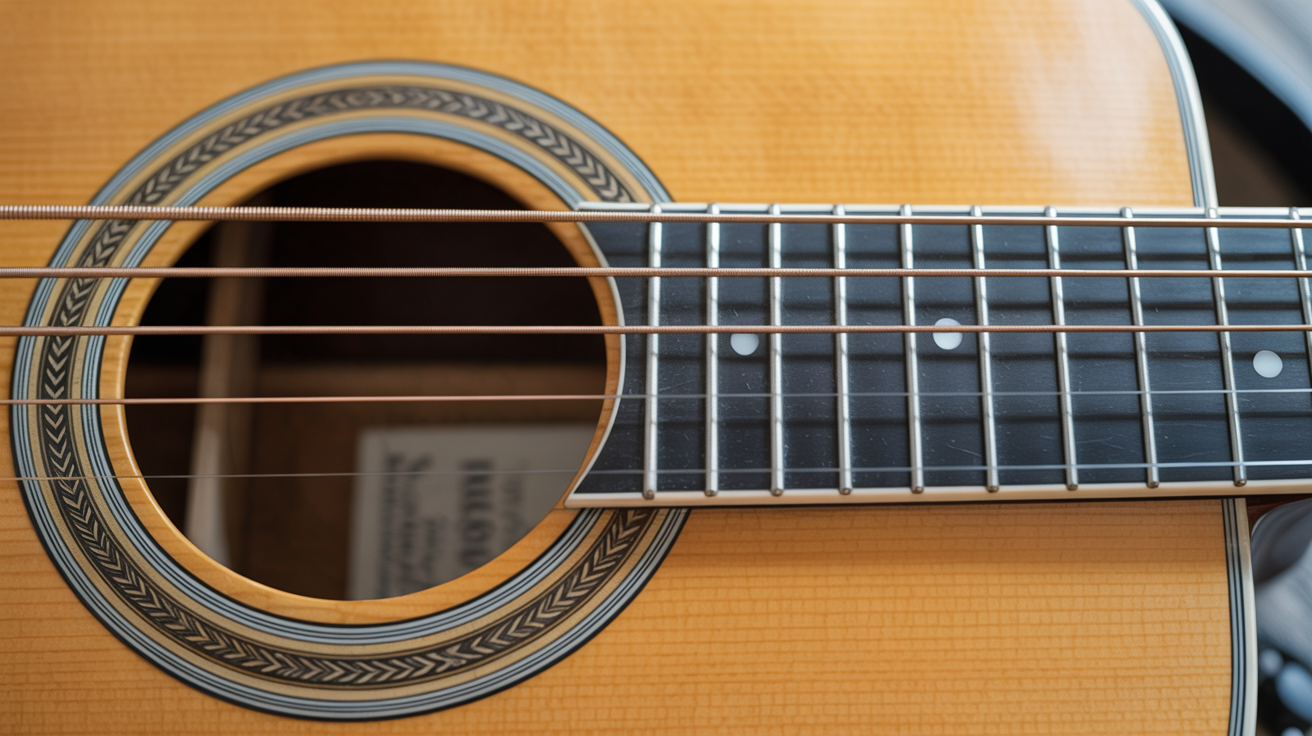
Standard tuning is what virtually every beginner lesson, chord chart, and tab assumes you're using. The six strings have specific pitches, and memorizing them early saves a lot of confusion.
| String | Note | Frequency | Memory trick |
|---|---|---|---|
| 6th (thickest) | E | 82.41 Hz | Every |
| 5th | A | 110.00 Hz | Amateur |
| 4th | D | 146.83 Hz | Does |
| 3rd | G | 196.00 Hz | Get |
| 2nd | B | 246.94 Hz | Better |
| 1st (thinnest) | E | 329.63 Hz | Eventually |
The phrase "Every Amateur Does Get Better Eventually" is a classic mnemonic, and it happens to be true.
The 6th string (low E) is the thick one closest to your chin when you hold the guitar. The 1st string (high E) is the thin one closest to the floor. They share the same letter name but are two octaves apart in pitch.
When people say a guitar is "in tune," they mean each string is vibrating at exactly the right frequency for its note, as defined by standard guitar tuning. A string that's too loose sounds flat (lower than it should be). A string that's too tight sounds sharp (higher than it should be). Tuning is just the process of adjusting tension until each string hits its target.
Those exact frequencies exist because standard tuning is built on concert pitch, where the note A above middle C is fixed at 440 Hz and every other note is calculated from it. You don't need to memorize any of that math. A tuner does the calculation for you every time you clip it on. It's just useful to know that "E" isn't a vague ballpark. It's one specific frequency, and a tuner is checking against it precisely.
How to Tune with a Clip-On Tuner or App
For beginners, a clip-on tuner or a free tuning app is the most reliable way to get in tune quickly. There's no shame in using one at every practice session. Professional guitarists use tuners constantly.
Clip-on tuners clamp onto the headstock of your guitar and detect pitch through vibration, which means they work even in noisy rooms. Pluck a string, watch the display, and turn the tuning peg until the needle or indicator centers on the correct note and turns green (or whatever the "in tune" color is on your model).
Tuning apps use your phone's microphone to detect pitch. They work well in quiet environments. Search your app store for "chromatic tuner" and you'll find several free options that do the job.
A few tips for using either method:
- Pluck the string firmly enough to get a clear reading, but don't strike it so hard the pitch spikes.
- Always tune up to the note rather than down. If your string is sharp, loosen it below the target pitch, then bring it back up. This helps the tuning peg hold its position more reliably.
- Go through all six strings twice. Adjusting one string can slightly shift the tension across the neck, pulling other strings fractionally out of tune. A second pass catches this.
- Turn the peg in small increments and re-pluck after each turn. Guitar tuning pegs have enough mechanical advantage that a quarter turn can swing the pitch further than you expect, especially on lighter strings.
- If you're also shopping for accessories, the guitar accessories beginners actually need guide covers clip-on tuner recommendations alongside the other basics worth having early on.
Reading a Chromatic Tuner Display
Most tuners show you the note name, a needle or bar indicator, and a flat/sharp symbol. The goal is to land dead center. If the display shows "Eb" when you're tuning the low E string, your string is flat. If it shows "E#" (or "F"), it's sharp. Keep adjusting until you see "E" with the indicator perfectly centered.
Some tuners also show an octave number next to the note, like "E2." That number matters more than it looks. It's the difference between tuning the low E string correctly and accidentally cranking it up an entire octave, which puts dangerous tension on a string that isn't built for it. If a string feels unusually tight and hard to turn while you're "tuning up" to a note, stop and double-check you're not an octave high before you keep going.
How to Tune by Ear: The 5th-Fret Method
Knowing how to tune by ear matters even if you own a tuner. Batteries die. Phones go flat. And training your ear to recognize when something sounds right is genuinely valuable as a musician.
The 5th-fret method works by using one string as a reference pitch and matching the next string to it. It assumes at least one string is already in tune. If you have a piano nearby, or can find a reference pitch online, use the low E string as your starting point.
Here's the process:
- Tune your low E (6th string) to a reference pitch.
- Press the 6th string at the 5th fret. That note is A. Pluck it, then pluck the open 5th string and adjust until they sound identical.
- Press the 5th string at the 5th fret. That note is D. Match the open 4th string to it.
- Press the 4th string at the 5th fret. That note is G. Match the open 3rd string to it.
- Press the 3rd string at the 4th fret (not the 5th). That note is B. Match the open 2nd string to it.
- Press the 2nd string at the 5th fret. That note is E. Match the open 1st string to it.
The 3rd-to-2nd string step is the one that trips people up because it uses the 4th fret instead of the 5th. Remember that exception and the rest follows a consistent pattern.
Tuning by ear takes practice. At first, the two strings might sound close but not quite right. Keep adjusting slowly and listen for the slight wavering sound that happens when two notes are nearly but not exactly the same pitch. That effect has a name: acoustic beating, the interference pattern between two close frequencies, and it's a reliable signal to listen for. As the two strings converge on the same pitch, the beating slows down and eventually disappears. When it's gone, you're there.
A worked example makes this concrete. Say your open 5th string (A) is slightly flat compared to the 6th string fretted at the 5th fret. You'll hear a pulsing "wah-wah-wah" sound, maybe three or four pulses a second. As you slowly tighten the 5th string, the pulses slow down: two per second, then one, then a slow wave every couple of seconds. When the pulsing disappears entirely and the two notes blend into one steady tone, the strings are matched.
Why Your Guitar Keeps Going Out of Tune
A freshly purchased guitar, especially one with new strings, will go out of tune constantly at first. This isn't a defect. It's just physics.
New strings stretch. Guitar strings are made of metal, and fresh ones haven't settled into their final tension yet. Every time you play, they stretch a little more and the pitch drops. The solution is to stretch them manually: after tuning, gently pull each string away from the fretboard a few times, then retune. Repeat until the strings stop going flat as quickly. It usually takes a day or two of playing.
Temperature and humidity shift the wood. Guitar necks are made of wood, which expands and contracts as conditions change. Bringing a guitar in from a cold car to a warm room, or from a dry climate to a humid one, can pull it noticeably out of tune. Always tune after any environment change.
Nut and tuning peg issues. On cheaper guitars, the nut slots (the small grooves at the top of the neck) can catch the string and cause it to slip suddenly. If your guitar goes out of tune with a "ping" sound when you pluck a string, this is likely the cause. It's a fixable problem, typically handled by a guitar shop with a bit of nut slot lubricant.
Understanding why strings go out of tune also connects to string maintenance generally. Knowing when and how to change your guitar strings is the natural next step, since old strings are harder to keep in tune and sound duller than fresh ones.
How Often Should You Tune?
Tune before every single practice session. And tune again if you pick the guitar up after a break of even an hour or two. As you develop your ear, you'll start noticing when something sounds off mid-song and you can fix it on the fly.
Does String Gauge Affect Tuning Stability?
Heavier strings (higher gauge numbers) hold tension better and can be more stable in tune, but they're also harder to press down. Lighter strings are easier on your fingers but can go out of tune faster, especially with aggressive playing. If tuning stability is a frustration, it's worth reading about how string gauges affect playability and tone before buying your next set.
Troubleshooting Common Tuning Problems
Most tuning frustrations trace back to one of a handful of causes. Use this as a quick diagnostic before you assume something is broken.
| What you notice | Likely cause | What to do |
|---|---|---|
| String won't stay in tune, drifts flat within minutes | New strings that haven't stretched yet | Stretch each string by hand after tuning, then retune. Repeat over a day or two. |
| Tuner reads correct note but chords still sound off | Wrong octave, or an intonation issue | Confirm the tuner shows the right octave number; if single notes are fine but chords aren't, the guitar may need an intonation setup. |
| String slips or makes a "ping" sound while tuning | Sticky or worn nut slot | Have a shop apply nut lubricant, or apply a small amount of pencil graphite to the slot as a temporary fix. |
| Whole guitar sounds off after moving it | Temperature or humidity change | Let the guitar sit at room temperature for 15 to 30 minutes, then retune. |
| Peg feels loose or won't hold tension | Worn tuning machine | Check for a loose screw on the tuner housing; if the mechanism itself is worn, it may need replacing. |
| String snapped while tuning up | Tuned an octave too high, or old/fatigued string | Always confirm the octave on your tuner before cranking a string that feels unusually tight. |
Frequently Asked Questions
Do I need to buy a tuner, or can I just use my phone?
A free tuning app works fine for most beginners. Phone microphones are sensitive enough to detect pitch accurately in a quiet room. A clip-on tuner is more convenient (no need to unlock your phone, works in noisy spaces, doesn't use your microphone), and they cost very little, so it's a nice thing to own eventually. But starting with an app is completely reasonable.
What does "standard tuning" mean?
Standard tuning refers to the specific pitches the six guitar strings are tuned to: E, A, D, G, B, E (from thickest to thinnest). It's called "standard" because it's the default setup that virtually all beginner material is written for. Other tunings exist (drop D, open G, and many others), but you won't need to think about those for a long time.
My tuner says my string is in tune, but it still sounds wrong. What's happening?
A few possibilities. First, check that your tuner is set to chromatic mode, not a preset for a different instrument. Second, make sure you're tuning to the correct octave. The 6th string should read "E2" on a tuner that shows octave numbers, not "E3" or "E4." Third, if the open string sounds fine but chords sound off, the issue might be intonation (the guitar's internal setup), which requires a setup by a tech rather than just adjusting the tuning pegs.
Why does my guitar sound okay when I play single strings but bad when I play chords?
This is usually an intonation issue or a technique issue. If you're pressing the strings down too hard or bending them sideways while fretting, you can push individual notes sharp. Try lightening your touch. If the problem persists, the guitar may need a professional setup to correct the intonation, which involves adjusting the saddle positions at the bridge.
How long does it take to learn to tune by ear?
Most beginners can reliably use the 5th-fret method within a few weeks of regular practice, even if it takes a few minutes at first. Developing pitch recognition to the point where you can hear a note and know roughly what it is takes much longer, months or years of active listening. Don't worry about that level for now. A tuner handles the job perfectly, and the 5th-fret method is there when you need it.
Can I actually break a string by tuning it wrong?
Yes, and it's one of the more common beginner mistakes. If you turn the peg the wrong direction while trying to bring a flat string up to pitch, you can accidentally push it a full octave too high without realizing it, since the note name repeats every twelve frets. The string will feel unusually stiff and tight right before it snaps. If a string ever feels tighter than expected while you're tuning up, stop, check the octave reading on your tuner, and loosen it back down before continuing.
Is it bad to leave my guitar tuned down when I'm not playing?
No. Detuning slightly (a half step or so) before long-term storage is common practice and reduces tension on the neck over time, though modern guitar necks are built to handle standard tuning tension indefinitely without issue. For day-to-day players who pick the guitar up regularly, there's no real benefit to detuning between sessions. Just retune when you sit down to play.