Strumming & Rhythm
Understanding Beats and Bars for Strumming Beginners
Learn how beats and bars work on guitar so your strumming stays in time. A plain-English guide to 4/4 time, counting, and keeping the groove.
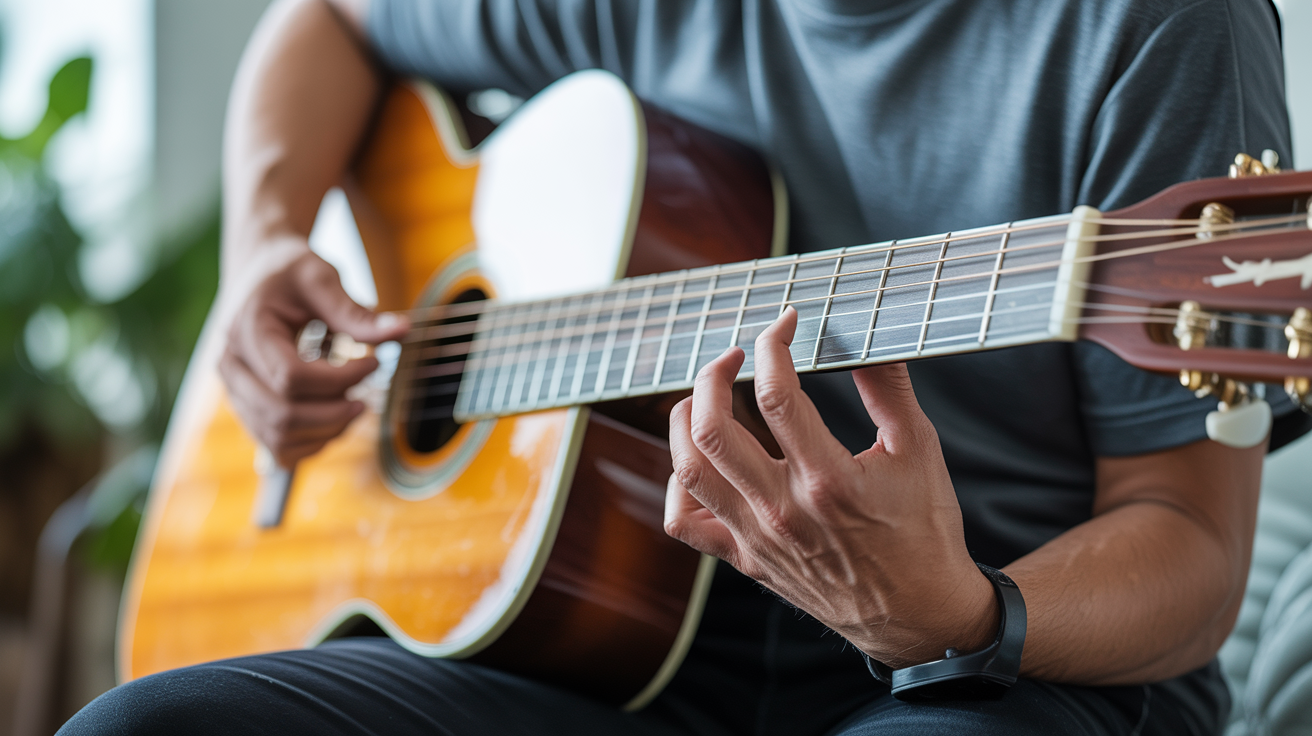
If your strumming feels unsteady or you lose your place while playing, the most likely cause is not your technique -- it is that beats and bars have never been explained clearly. Once you understand them, counting becomes automatic and everything else clicks into place.
What a Beat Is (and Why It Matters)
A beat is the steady pulse underneath music. Tap your foot while listening to any song and you are tapping beats. They are evenly spaced, they do not speed up or slow down, and they are what every strum you play needs to line up with.
Think of beats like a ticking clock. The clock does not know whether you are playing a ballad or a blues number -- it just keeps ticking at the same rate. Your job as a rhythm player is to match your strums to that tick.
When beginners rush or drag, it almost always comes from ignoring the beat and reacting to what the fretting hand is doing instead. The fix is simple: make the beat the boss, not the chord change.
What a Bar Is
A bar (also called a measure) is a container that holds a fixed number of beats. When that container fills up, you start a new one.
In most popular music, a bar holds four beats. You count it like this:
1 - 2 - 3 - 4 - 1 - 2 - 3 - 4 - 1 - 2 - 3 - 4 ...
Each group of four is one bar. The number 1 that starts each group is called the downbeat, and it is a natural anchor point. If you get lost, wait for the next 1 and jump back in there.
Songs are built from bars. A verse might be eight bars. A chorus might be another eight. Once you can feel where the bars start and end, song structure starts to make sense too.
Time Signatures: Reading the Numbers
A time signature tells you how many beats are in each bar and what kind of note gets one beat. You see it at the start of written music as a fraction-like symbol.
The two numbers you will meet most often as a beginner:
| Time signature | Beats per bar | How it feels |
|---|---|---|
| 4/4 | 4 | The most common; steady, natural to tap along to |
| 3/4 | 3 | A waltz feel; count 1-2-3, 1-2-3 |
| 6/8 | 6 (grouped in 2) | A lilting, rolling feel; common in folk and ballads |
For now, focus almost entirely on 4/4 time strumming. Well over half the songs a beginner wants to learn sit in 4/4. Once that groove is solid, 3/4 takes about five minutes to understand because the counting is the same -- just one beat shorter per bar.
Counting Beats in 4/4
Out loud, count four beats in a steady loop:
1 - 2 - 3 - 4 - 1 - 2 - 3 - 4
Now add the word "and" between each number:
1 - and - 2 - and - 3 - and - 4 - and
The numbered beats are downbeats. The "ands" are upbeats. Every strum pattern you will ever learn fits somewhere on that grid. A down strum usually lands on a numbered beat; an up strum usually lands on an "and."
This grid is the foundation of how to strum a guitar: the down-up motion for beginners.
How to Count Beats While You Play
Counting out loud while playing feels awkward at first. Do it anyway. It is the fastest way to make the beat internal.
Step 1: Start without the guitar. Tap your foot and count "1, 2, 3, 4" at a tempo where the four beats feel completely natural. Do not rush this.
Step 2: Add air strums. Keep counting, tap your foot, and wave your strumming hand down on each beat. No guitar yet. You are training the hand-and-count connection.
Step 3: Pick up the guitar. Fret one open chord (G or Em work well) and strum down on beats 1, 2, 3, and 4 while counting aloud. Keep the tempo slow.
Step 4: Add the upstrokes. Once four steady downstrokes feel locked in, try adding an upstroke on the "and" after beat 2: "1, 2-and, 3, 4." That one extra strum is where most common patterns begin.
A metronome or drum-machine app makes this easier because it removes the mental load of keeping time yourself. Set it around 60-70 BPM to start. Speed is not the goal here -- steadiness is.
For a practical look at how to keep time and strum in rhythm, metronome practice is covered in detail there.
Applying Beats and Bars to Real Songs
Once you can count four beats while strumming, you can navigate any song that uses a chord chart or a simple lyric sheet.
Most chord charts tell you how many beats or bars each chord lasts. For example:
G (4 beats) - C (4 beats) - D (4 beats) - G (4 beats)
That is four bars of 4/4, one chord per bar. You strum through four beats on G, then change to C for four beats, and so on.
When a chart says a chord lasts two bars, that means eight beats before you change. When it lasts half a bar, that means two beats. Counting lets you track those numbers without guessing.
The same skill makes it easy to learn 5 easy strumming patterns behind most songs, because every pattern is just a specific arrangement of strums across the four-beat grid you already know.
A Quick Reference: Beats and Bars at a Glance
| Term | What it means | Example |
|---|---|---|
| Beat | One steady pulse in the music | The tap of your foot |
| Bar (measure) | A group of beats | Four beats in 4/4 |
| Downbeat | Beat 1 of a bar | The first tap, the "1" |
| Upbeat ("and") | The halfway point between beats | Between 1 and 2 |
| 4/4 time | Four beats per bar | Most pop, rock, folk songs |
| Tempo | The speed of the beats | 60 BPM = 60 beats per minute |
Frequently Asked Questions
How do I know which beat to strum on? Start by strumming on every beat (four down strums per bar). Once that feels automatic, start leaving some beats out or adding upstrokes on the "ands." There is no rule that says you must strum on every beat -- the grid just tells you where each strum can land.
What is the difference between tempo and time signature? Time signature tells you how beats are grouped (four per bar in 4/4). Tempo tells you how fast those beats go, usually given as beats per minute (BPM). A 4/4 song at 60 BPM is slow and relaxed; the same 4/4 song at 140 BPM is fast and driving. The grouping stays the same; only the speed changes.
Why do I lose count when I change chords? Most beginners stop mentally counting the moment a chord change arrives because the fretting hand demands attention. The fix is to make chord changes so familiar that they need less focus -- slow repetition until the change feels reflexive. In the meantime, keep your foot tapping even when your brain temporarily loses the count. The foot often holds the groove when the mind wanders.
Do I need to read music to understand time signatures? No. You just need to know the two numbers at the top of sheet music or a tab, and for the vast majority of beginner songs that number will be 4/4. Most players work entirely from chord charts and tablature and never read standard notation. Understanding 4/4 counting is enough to get you through hundreds of songs.
How long does it take for this to feel natural? A few weeks of daily practice with a metronome is usually enough for 4/4 to feel automatic. The goal is to count internally rather than out loud, and that happens when your foot and hand are so used to the pulse that the brain stops having to manage it consciously. It feels slow at first, then one day it just clicks.