Strumming & Rhythm
How to Keep Time and Strum in Rhythm
Learn how to keep time on guitar with simple techniques for counting beats, tapping your foot, and using a metronome.

Most beginners focus on chord shapes and finger placement, which makes sense. But the thing that makes music actually sound like music is rhythm, and learning how to keep time on guitar is often what separates someone who "plays guitar" from someone who sounds like they know what they're doing. Good timing is learnable, and it doesn't require a natural gift for it.
Count Out Loud: 1-2-3-4
Before you touch a string, understand that almost every song you want to play is built on a four-beat cycle. One measure equals four beats: 1, 2, 3, 4. Then it repeats. That's it.
When you're practicing, say these numbers out loud as you play. It sounds silly. Do it anyway. Your brain needs a concrete anchor to stay on track, and counting is that anchor.
Here's a simple way to start:
- Set a timer for two minutes.
- Fret any chord you're comfortable with (a G or Em works fine).
- Strum once on each beat while counting out loud: "1, 2, 3, 4, 1, 2, 3, 4..."
- Keep every strum even. Same volume, same pressure, same spacing.
The goal isn't to sound musical yet. The goal is to feel the grid. Once you feel it in your body, your strumming patterns will have something to lock onto.
You can also count eighth notes, which fills in the "ands" between beats: "1-and-2-and-3-and-4-and." Most strumming patterns live in this space. If a strum happens on "and," it falls exactly halfway between two numbered beats. Knowing this makes learning down-up strumming motions much easier because you understand where each motion fits in the count.
Tap Your Foot (Seriously)
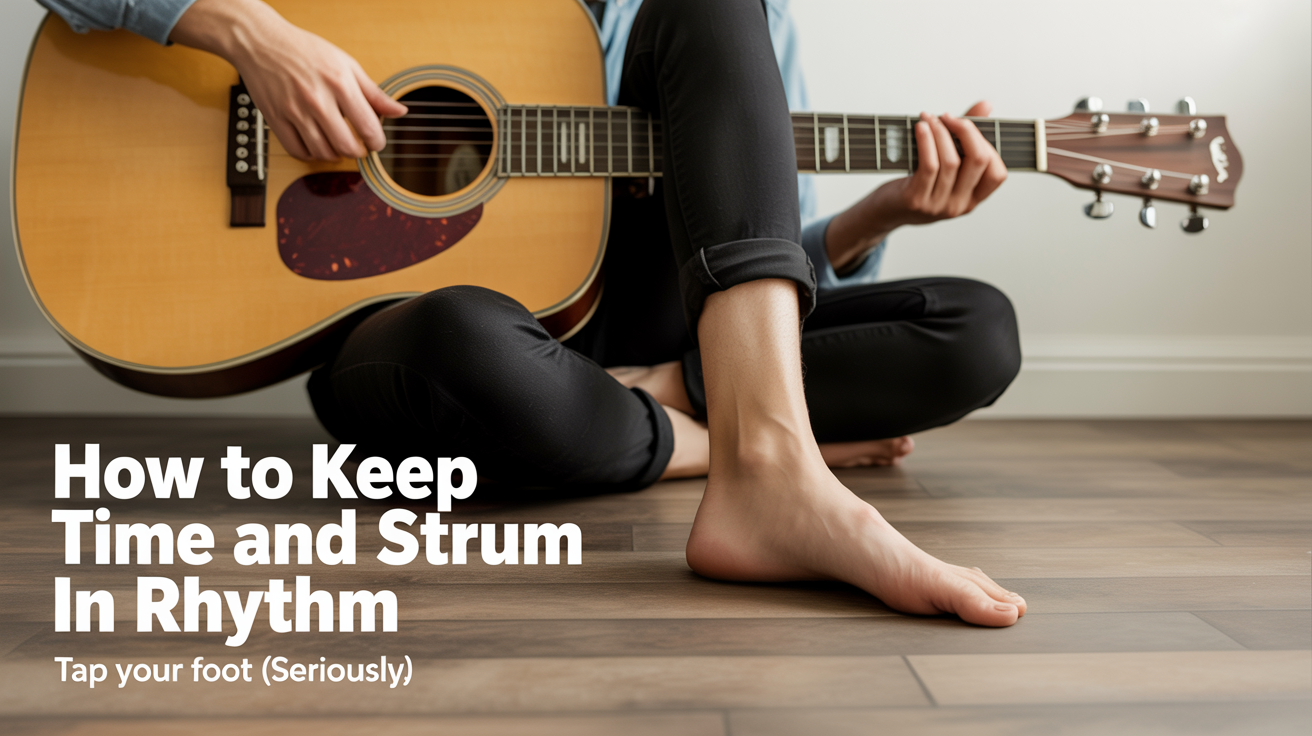
Your foot is a metronome you already own. Tapping it while you play creates a physical feedback loop that keeps you grounded when your attention is split between chord shapes, strumming patterns, and everything else happening at once.
The tap corresponds to the beat, usually beats 1, 2, 3, and 4. Your foot goes down on the beat, comes up on the "and." This mirrors what your strumming hand should be doing. When they sync up, playing in time on guitar starts to feel natural rather than forced.
Some players resist this because it feels awkward or performative. Push past that. After a few weeks of consistent practice, the foot tap becomes automatic, and you can drop it once your internal clock is reliable. Until then, treat it like training wheels you actually need.
One common mistake is letting the foot tempo drift when a chord change gets difficult. If you notice your tapping speed up during hard transitions, that's the issue to fix. Slow down the whole thing rather than rushing through the hard part.
Keep the Strumming Hand Moving
This is the single most useful tip for guitar timing for beginners, and it's counterintuitive: keep your strumming hand moving even when you're not hitting the strings.
Think of your hand as a pendulum. It swings down on beats 1, 2, 3, 4 and up on the "ands." If you stop the pendulum to think, you lose the rhythm. If you ghost-strum (move the hand without contacting the strings), you stay in time.
A pattern like "down, down-up, up-down-up" gets much easier when you realize the hand never stops swinging. You're just choosing which swings connect with the strings and which ones don't. Practice common strumming patterns this way and the timing clicks into place faster than you'd expect.
Try this exercise:
- Set a slow tempo (we'll cover metronomes next).
- Keep your strumming hand moving in a constant down-up pendulum.
- Strum only on beat 1 at first. Let the hand keep moving through beats 2, 3, and 4 without touching the strings.
- Add beat 3. Now you're strumming 1 and 3, hand moving the whole time.
- Gradually add more hits until you reach your target pattern.
This builds muscle memory for the rhythm before you load in chord changes. Speaking of which: once the strumming is solid, changing chords mid-strum becomes the next challenge, and the pendulum habit makes that transition smoother.
Use a Metronome from Day One
A metronome is a click track that pulses at a fixed tempo, measured in beats per minute (BPM). At 60 BPM, you get one click per second. At 120 BPM, two clicks per second.
Free metronome apps are everywhere. Most guitar apps include one. A physical metronome works fine too. The specific tool doesn't matter; using one consistently does.
Why a metronome beats playing along to songs when you're starting out: Songs speed up and slow down, often subtly. A metronome doesn't. It exposes your drift immediately and gives you something completely reliable to lock onto.
Suggested practice tempos:
| Skill Level | Starting BPM | Target BPM |
|---|---|---|
| Total beginner | 50-60 | 70-80 |
| Some experience | 70-80 | 90-100 |
| Comfortable basics | 90-100 | 110-120 |
Start slower than you think you need to. 60 BPM feels almost too slow, and that's the point. At that speed you can hear exactly when you rush or drag. Tighten up the slow tempo first. Speed comes naturally once the timing is clean.
A useful drill: play your chord progression at 60 BPM until you can do it cleanly for 60 seconds without a single rushed chord change or missed strum. Then bump to 65 BPM and repeat. This incremental approach builds real precision rather than the illusion of it.
Practice With a Drum Track
Once you've built a foundation with the metronome, drum tracks are a great next step. A drum groove has a pulse like a metronome, but it also has a feel, a sense of where the downbeats land and how the pattern breathes. Playing over drums teaches you to lock in with another instrument, which is how music actually works.
YouTube has thousands of drum loops in every tempo and style. Search "60 BPM drum loop" or "90 BPM rock drum loop" and pick one. These aren't songs, just repeating grooves, so there's no pressure to know the tune.
Notice what happens when you drift out of time against a drum track. The clash is obvious. That immediate feedback is the whole point.
Frequently Asked Questions
How long does it take to develop good timing on guitar?
Most beginners notice real improvement within four to six weeks of consistent practice with a metronome, meaning 20 to 30 minutes most days. Timing is a skill like any other: it responds to focused repetition. Players who skip the metronome and just strum along to songs can take months longer to develop the same precision.
Should I always use a metronome when I practice?
Not necessarily. Metronome practice is essential for building precision, but playing along to songs you enjoy builds musicality and feel. A good balance for beginners is roughly half the practice time with a metronome, half without. The metronome work makes the free-play sound better over time.
Why do I keep speeding up during chord changes?
Rushing through chord changes is one of the most common timing problems for new players. It usually happens because the chord change feels uncertain, so your body tries to get through it faster. The fix is almost always to slow down the tempo until the change is comfortable, then gradually increase speed. Trying to "power through" at full speed usually locks the habit in rather than curing it.
Is it okay to count in my head instead of out loud?
Out loud is better, especially early on. When you count silently, it's easy to skip beats or lose track without realizing it. Saying the numbers out loud forces you to keep a steady internal clock because you'd hear immediately if it skipped. Once your timing is solid, silent counting works fine.
Does playing with other people help with timing?
Yes, a lot. Jamming with even one other guitarist or a drummer creates immediate, natural feedback. You either lock in with the other person or you don't, and there's no faking it. If you have access to a practice partner or a local jam session, use it. The social pressure of playing with someone else accelerates timing development faster than solo practice alone.