Technique & Practice
Relaxed Hand Position: Avoiding Tension and Strain
Learn proper guitar hand position for beginners: how to relax your fretting hand, set thumb position, avoid wrist pain, and play longer without tension.

Tension is the most common hidden problem for new guitar players. You press too hard, grip too tight, and within ten minutes your hand feels like a claw. The fix is not to "try to relax" as a vague idea. It comes from specific adjustments to how you hold the neck, where your thumb sits, and how much pressure you actually need to make a clean note. Make those adjustments and you can practice longer with far less fatigue.
If you feel sharp or lasting pain in your hand, wrist, or shoulder while playing, stop and rest. Pain that persists beyond a session warrants a visit to a doctor or physiotherapist, not more practice. This is not an abstract warning: a systematic review of overuse injuries in musicians found that playing-related musculoskeletal disorders affect roughly 37-47% of musicians at any given time, with lifetime prevalence as high as 89%, and that incorrect playing technique is one of the main identified risk factors (Betzl et al., 2020). Fixing your hand position early is not fussing over details; it is the single biggest thing you control.
At a Glance
- Most tension comes from squeezing harder than the note requires, not from weak hands. Find the minimum pressure that keeps a note clean and stop there.
- Curl your fingers so the fingertip, not the pad, contacts the string. This gives better clearance and needs far less force.
- Keep your thumb behind the neck, roughly opposite your middle finger, for most open-chord playing.
- A wrist bent sharply inward compresses tendons and limits reach. Keep a slight outward curve instead.
- Fingertip soreness in the first few weeks is normal. Joint pain, tingling, or pain that lasts after you stop playing is not, and is a signal to rest.
- Playing-related hand and wrist injuries are common enough among musicians generally that prevention through good technique, not toughing it out, is the standard advice.
Why Tension Builds in the First Place
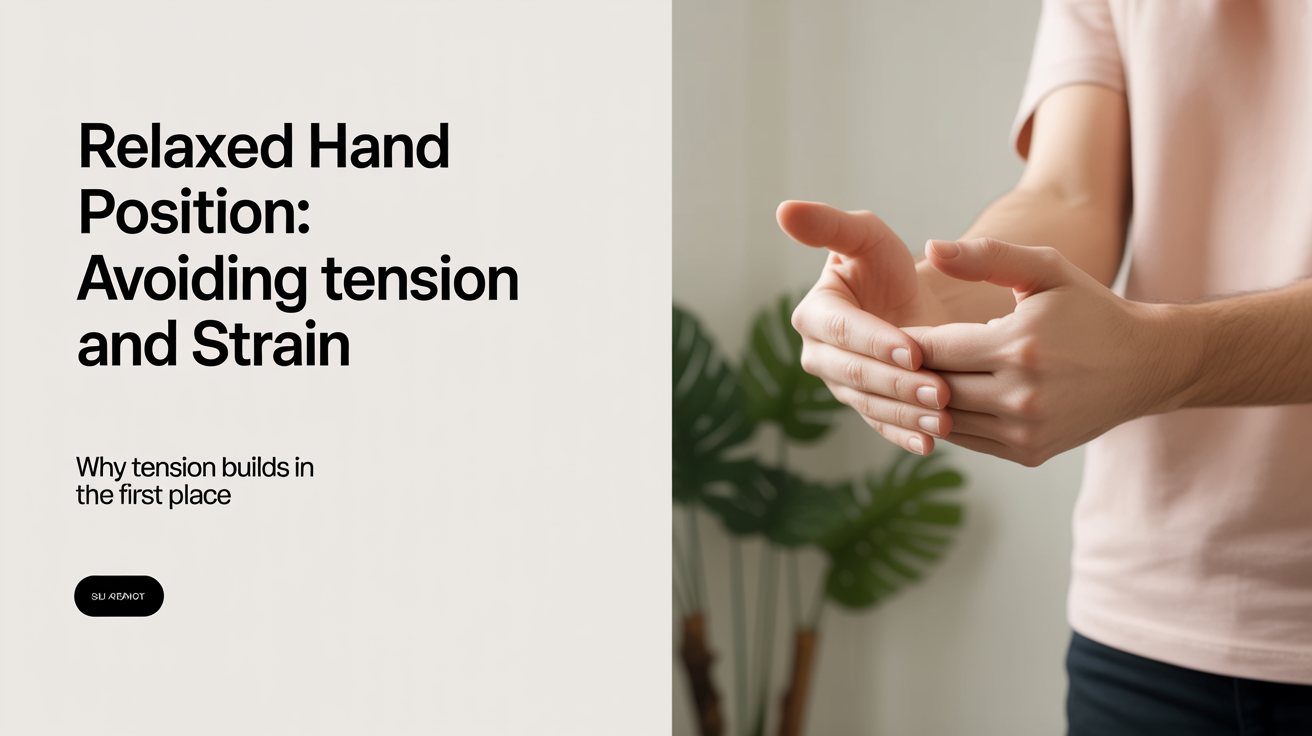
Most beginners grip the neck like they are holding something that might fall. The guitar is not going anywhere. The instinct to squeeze comes partly from the fear of muted strings and partly from posture that forces the wrist to compensate for what the arm position cannot reach.
Two things drive that squeeze:
- Action that is too high. On a badly set-up guitar, strings sit far above the frets and genuinely require more pressure. If you have borrowed or bought a budget instrument that has never been looked at by a tech, high action may be making your hand work twice as hard as it needs to. A basic setup costs less than most beginners expect, often $40-80 at a local shop, and makes a real difference.
- Pressing in the wrong part of the fret. Pressing in the middle of the fret space instead of just behind the fret wire means you need much more force to get a clean sound. Move your fingertip as close to the fret wire as possible without sitting on it.
A third, less obvious driver is simply not knowing what "enough" pressure feels like. Nobody hands new players a reference point, so most default to squeezing as hard as they can, which is far more than any note requires. The minimum-pressure exercise below exists to give you that missing reference point.
Fretting Hand Position: The Core Adjustments
Curl Your Fingers, Don't Flatten Them
Each finger should approach the string from above with a curved shape, so the fingertip (not the pad) makes contact. A curved finger gives you better string clearance so you don't accidentally mute adjacent strings, and it lets you press with far less force.
Hold your fretting hand in front of you as if you are gripping a small ball. That curve is roughly what you want when you move your hand to the neck.
How Much Pressure Is Enough
Press a string down and play it. Then, while the note is ringing, slowly reduce the pressure until the note starts to buzz. Stop right there. That threshold is all you need. Most beginners press at roughly triple the required force. Practise finding and holding that minimum-pressure point on single strings before worrying about full chords.
Do this test on each string individually, since the required pressure isn't identical across the neck. Thicker, lower strings need slightly more force than the thin high strings, and the same string needs more force near the middle of the neck than right next to the nut, where the string sits closer to the fret already.
Keep Your Wrist Loose
The wrist should hang below the neck with a slight outward curve, not bent sharply inward. A sharp inward bend compresses tendons and limits finger reach. If you find your wrist bending at a tight angle, try dropping your elbow slightly or adjusting the guitar angle. For seated practice, a strap set short enough to keep the headstock up helps more than most players expect.
Thumb Position on the Guitar Neck
Where your thumb sits on the back of the neck affects every finger on the front of it.
The general guideline for most chord playing: thumb behind the middle finger, pointing roughly toward the ceiling, sitting in the middle of the back of the neck. This position lets your fingers arch over the strings cleanly.
There are situations where the thumb creeps over the top of the neck, particularly when playing chord shapes that need the thumb to fret the low E string. That is fine once you have the technique to support it. For most open chords as a beginner, keep the thumb behind the neck.
| Thumb too high (hooks over top) | Thumb behind the neck |
|---|---|
| Wrist collapses inward | Wrist can stay open |
| Fingers flatten against strings | Fingers can curl properly |
| Harder to reach high strings | Better reach across all strings |
| Common in chord playing without the technique to support it | Starting position for most beginners |
Avoiding Guitar Wrist Pain During Practice
Guitar wrist pain at the fretting hand usually comes from one of three sources: too much tension in the grip, a wrist angle that is held for too long, or practice sessions that go longer than the hand is ready for. The National Institute of Arthritis and Musculoskeletal and Skin Diseases describes this general pattern in overuse injuries: they "result from overuse of one area of the body (repetitive overload) and develop gradually over time," with pain during the activity as an early symptom worth acting on rather than ignoring.
A few practical steps:
- Warm up before you play. Simple finger stretches and wrist rotations before picking up the guitar prepare tendons for the work ahead. Check out guitar finger exercises and warm-ups for beginners for a short warm-up sequence, ideally done before every session, not just the first one of the day.
- Take breaks during practice. Set a timer. Every 20 to 25 minutes, put the guitar down and shake your hands out loosely for 30 seconds. Stiffness that builds slowly is easy to ignore until it becomes real pain.
- Keep sessions short at first. A new player's tendons need time to adapt to the work. Starting with shorter, focused sessions is not a workaround. It is the correct approach. How long should beginners practice guitar each day covers sensible starting session lengths.
- Stop if something hurts. Fatigue is normal. A dull ache after a long session is normal. Sharp pain, tingling, or pain that continues after you stop playing is a signal to rest and, if it persists, to consult a medical professional.
Building Good Habits from the Start
The easiest time to build a relaxed hand position is right now, before muscle memory has a chance to lock in a tense grip.
Spend a few minutes at the start of each practice session playing single notes with the minimum pressure technique described above. Fret a note, find the threshold, hold it there. Then move to two-note shapes, then full chords. The habit of checking your tension level before you run through material will carry over into your playing automatically over a few weeks.
When you move to chord changes, it helps to release grip pressure slightly as you lift your fingers between chords rather than staying squeezed the whole time. Your hand gets a micro-rest on every chord transition. Over a full practice session made up of dozens of chord changes, those micro-rests add up to meaningfully less cumulative tension than a hand that stays clenched between every change.
Pairing this with a consistent daily guitar practice routine means the habit reinforces itself session to session instead of being something you remember to think about occasionally.
Frequently Asked Questions
My fingers hurt after practice. Is that normal?
Fingertip soreness from pressing the strings is normal and expected for new players. The skin on your fingertips toughens over the first few weeks of regular playing. What is not normal is pain in the joint of a finger, inside the wrist, or up the forearm. If you feel that kind of pain, stop the session and rest. If it recurs or does not go away with rest, see a doctor.
How do I know if my thumb position is wrong?
If you cannot reach the high E string without your wrist bending sharply inward, or if your fingers feel like they cannot arch properly, your thumb is likely too high on the neck. Try moving it down toward the center of the back of the neck and see whether your fingers gain range.
I keep muting strings accidentally. Is that a tension issue?
Often yes. Flat fingers mute adjacent strings. Check that your fingers are curved and that you are pressing with the very tip rather than the pad. Also check that your thumb position is not forcing your fingers to flatten.
How long before playing feels less tiring?
Most beginners notice a real difference after three to four weeks of regular, short sessions. The tendons and muscles adapt, your minimum-pressure technique improves, and fretting starts to feel less effortful. Rushing sessions and skipping rest days slows that adaptation down.
Should I see a guitar teacher about my hand position?
A teacher watching your hand in person can spot tension issues in seconds that would take you weeks to diagnose from written advice. If you have recurring wrist pain or persistent muting problems, a single lesson focused specifically on technique is worth more than months of self-correction.
Is guitar-related hand pain actually common, or am I doing something unusually wrong?
It's more common than most beginners assume, and it isn't limited to guitar. Research on musicians across instruments consistently finds playing-related musculoskeletal complaints in a large share of players over a career, with incorrect technique named as one of the main risk factors alongside practice intensity and instrument setup. That doesn't mean pain is something to accept as inevitable. It means technique fixes like the ones in this guide are genuinely preventive, not just theoretical advice.