Technique & Practice
Guitar Finger Exercises and Warm-Ups for Beginners
The best guitar finger exercises for beginners, from chromatic walks to spider drills, so your hands stay loose and ready to play.
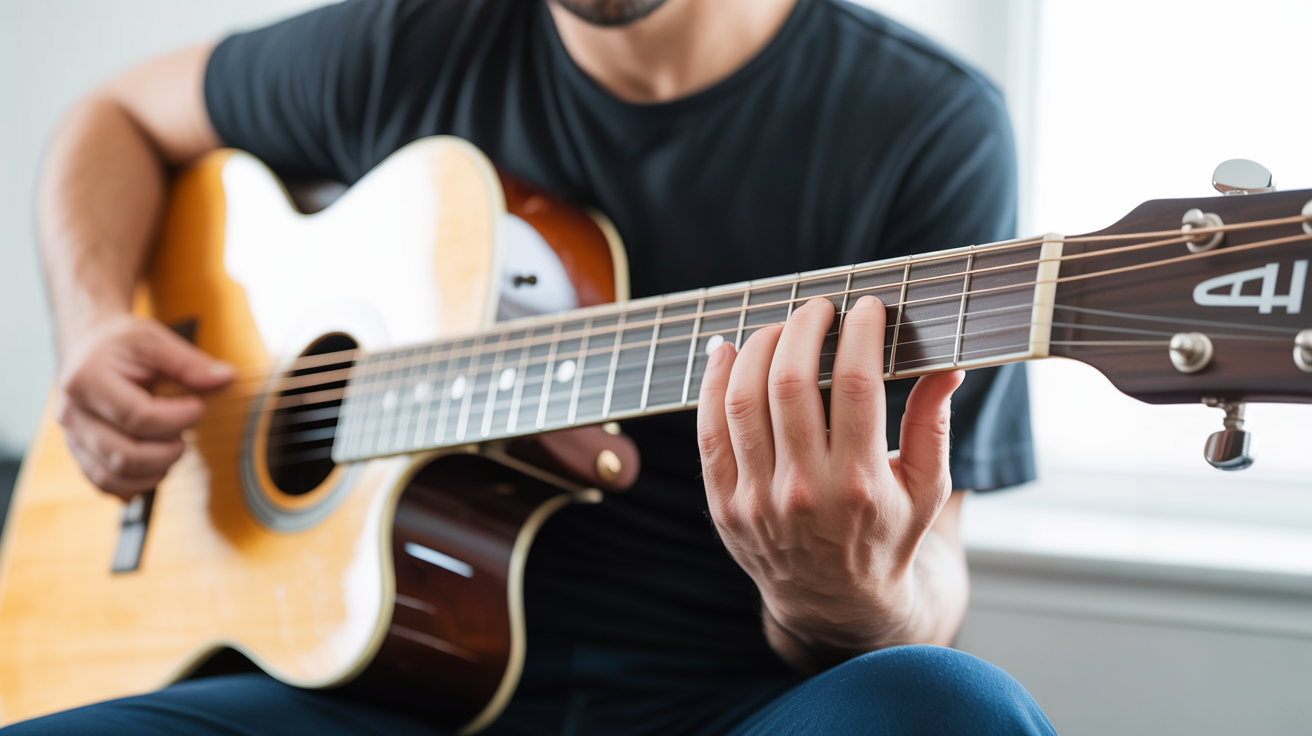
Your fingers feel stiff when you first pick up the guitar, and that is completely normal. Cold hands make chords harder to press, transitions slower, and playing less enjoyable. A five-minute warm-up routine changes that. The exercises below are simple enough to do on day one, and useful enough to keep doing for years.
Before you start, one non-negotiable rule: stop immediately if you feel sharp pain, numbness, or tingling. Mild muscle fatigue is fine; joint pain is not. Tendons and ligaments need time to adapt. Shorter sessions done consistently beat long sessions that leave your hand aching.
At a Glance
- Warm up for two minutes off the guitar (shaking, fist-and-spread, wrist circles) before any drill, cold hands press strings less accurately.
- The chromatic 1-2-3-4 walk is the single most useful beginner drill: one finger per fret, moving string to string.
- The spider exercise builds coordination faster than the chromatic walk because the finger order is less predictable; start around fret 5, where there's more room between frets, and move toward the lower frets as your hand opens up.
- Your ring finger and pinky lag behind on purpose, not from lack of effort. They share connective tissue with neighboring fingers, so isolating them takes deliberate drilling.
- Five minutes a day beats thirty minutes once a week. Consistency builds the coordination; duration barely matters past the five-minute mark.
- Stretch after playing, not instead of warming up before. The two serve different purposes.
A Gentle Warm-Up Before You Drill
Jumping straight into technical exercises on cold hands is a bit like sprinting without stretching first. Spend two minutes warming up before anything else.
Off-guitar warm-up:
- Shake your hands loosely at the wrist for 10 seconds.
- Make a fist, hold for two seconds, then spread your fingers wide. Repeat 6 times.
- Roll each wrist slowly in circles, five rotations each direction.
On-guitar warm-up (simple open-string picking): Pick each open string once, starting from the low E (6th string) and working to the high e (1st string), then back again. Do this two or three times at a very slow, even pace. You are not practicing anything musical here. You are just waking up your picking hand and getting used to the feel of the instrument. Think of it as saying hello to the guitar.
The 1-2-3-4 Chromatic Walk
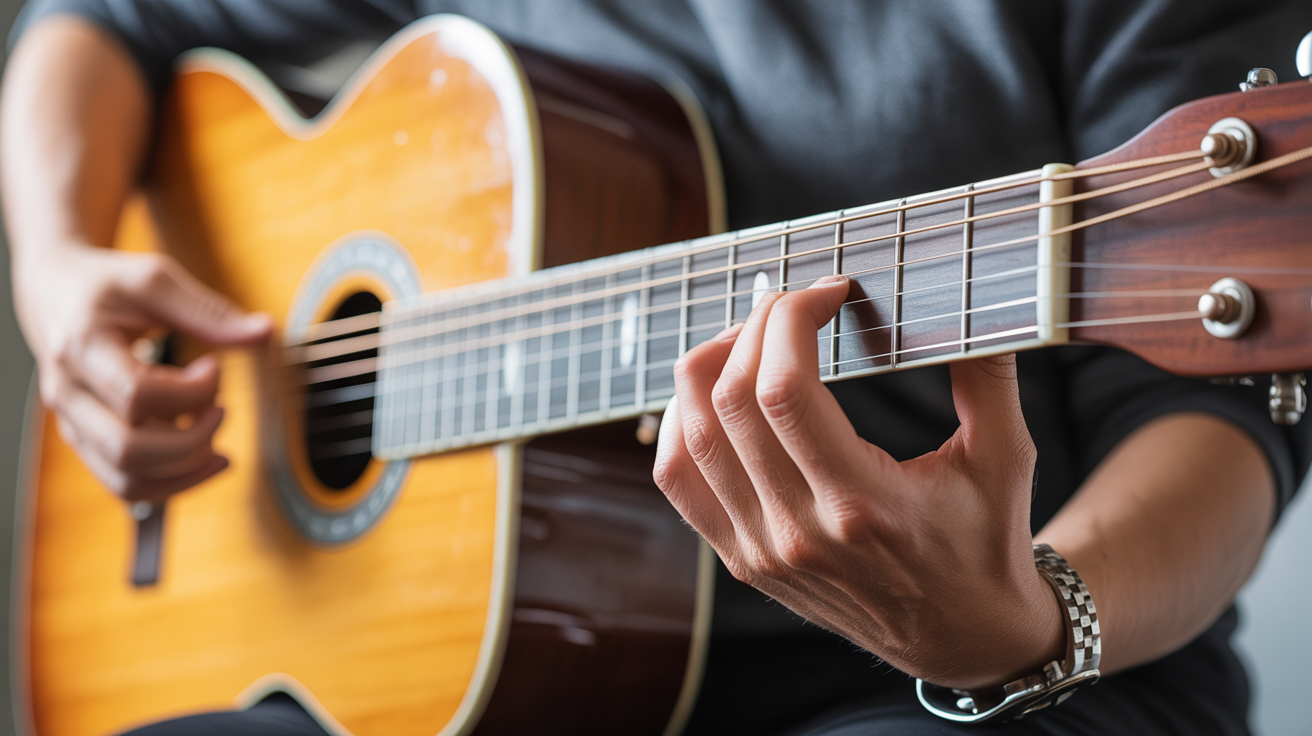
This drill moves one fret at a time through the chromatic scale, and it's probably the most recommended beginner drill for good reason. It trains each finger to move independently, builds basic fret-hand coordination, and gives you something concrete to measure progress against.
How to play it:
- Start on the 6th string (low E), 1st fret. Place your index finger there.
- Press and pick the note, then place your middle finger on the 2nd fret of the same string. Pick it.
- Place your ring finger on the 3rd fret. Pick.
- Place your pinky on the 4th fret. Pick.
- Move to the 5th string and repeat: frets 1, 2, 3, 4.
- Continue through all six strings, then reverse direction (from the 1st string back to the 6th).
Things to watch:
- Keep fingers close to the strings. Lifting them too high wastes motion and slows you down.
- Press just behind the fret wire, not on top of it and not a centimeter back from it.
- One finger per fret. Don't let earlier fingers float off the string while you place the next one.
Start at a tempo where every note rings out cleanly. Buzzing means you are going too fast or pressing in the wrong spot. Speed comes later; clean tone comes first. A full pass, six strings up and six strings back, is 48 notes. At a slow 60 BPM with one note per beat, that takes under a minute, which is why this drill fits easily into even a rushed five-minute warm-up.
If you want to build a full practice structure around exercises like this, the guide on how to build a daily guitar practice routine that works covers how to balance drills with actual music.
The Spider Exercise for Guitar
The spider exercise gets its name from the way your fingers creep across the strings in an alternating pattern, like a spider picking its way across a web. It is harder than the chromatic walk because your fingers move across strings in a less predictable order, which forces your brain and hand to communicate more carefully.
One common spider pattern:
| Beat | Fret-hand finger | String |
|---|---|---|
| 1 | Index (1) | 6th string, fret 5 |
| 2 | Middle (2) | 5th string, fret 6 |
| 3 | Ring (3) | 6th string, fret 7 |
| 4 | Pinky (4) | 5th string, fret 8 |
Then shift the same pattern to strings 5 and 4, then 4 and 3, and so on until you reach the 1st string. Come back the same way.
The specific frets matter less than the concept. Starting around fret 5 gives your fingers more room to spread without straining, which is important early on. As your hand opens up over weeks of practice, you can move toward frets 1 through 4.
Go slow. This exercise exposes coordination gaps fast. If your ring finger keeps hesitating or your pinky lifts too early, that is useful information. You have found something worth working on.
Finger Independence Drills
Most beginners discover quickly that the ring finger and pinky do not cooperate as well as the index and middle fingers. That is because tendons in the ring and pinky fingers share connective tissue, making them harder to move separately, and this isn't just a beginner's impression. A hand-biomechanics study measuring how much each finger moves involuntarily when a neighboring finger moves found the ring finger to be the least independent of the four, with an independence score roughly 40% lower than the index finger's, and the little finger not far behind (Li et al., 2004). You can improve this over time with targeted drills, but you're working against real anatomy, not just a bad habit.
Finger independence index, lowest to highest (Li et al., 2004):
| Finger | Independence index | What it means in practice |
|---|---|---|
| Ring | 0.48 | Moves the most when a neighbor moves; needs the most isolated drilling |
| Little (pinky) | 0.61 | Also enslaved to neighbors, but less than the ring finger |
| Index | 0.81 | Most independent finger measured; moves cleanly on its own |
A score of 1.0 would mean a finger moves with zero involuntary help from its neighbors. The gap between the ring finger's 0.48 and the index finger's 0.81 is the anatomical reason the spider exercise and stationary hold drill feel so much harder on your ring finger than on your index.
Stationary hold drill:
- Place all four fingers on the 3rd, 4th, 5th, and 6th frets of any string.
- Lift only your pinky. Hold it up for two seconds. Lower it.
- Lift only your ring finger. Hold for two seconds. Lower.
- Alternate slowly, keeping the other three fingers pressed down.
This feels awkward at first. Your ring finger may want to drag the pinky up with it or refuse to lift at all without the pinky. That is the exact problem you are trying to solve, and it does improve with patience, since the tendon interconnections that cause this are partly slack that tightens with repeated, deliberate isolation.
Tap-tap-tap on a table:
You do not even need the guitar for this one. Place your fretting hand flat on a desk and tap each finger independently in sequence: index, middle, ring, pinky, then reverse. Try to keep the other fingers relaxed on the surface rather than rising with the active finger.
This is a good drill for days when your practice time is short and you want to keep the muscles engaged without setting up the guitar.
Finger Stretches for Guitar Players
Stretching after playing (or after a warm-up set) helps reduce tension that builds up in the tendons and palm. Do these gently. You should feel mild pulling, not discomfort.
Prayer stretch: Press your palms together in front of your chest with fingers pointing upward. Slowly lower your hands toward your waist while keeping the palms touching. Hold for 15 seconds.
Reverse prayer (or wrist flexor stretch): Extend your fretting arm in front of you, palm facing down. Use your other hand to gently pull your fingers back toward your body. Hold for 15 seconds, then do the same with fingers pointing down.
Individual finger pull: Hold one finger gently and pull it back slightly toward the back of your hand. Nothing aggressive. Five seconds per finger, then move on.
These stretches take under two minutes total. They are easy to skip, but your hands will thank you if you make them a habit.
Finger comfort is also connected to your callus development. If pressing strings feels painful rather than just firm, it may be a callus issue rather than a technique issue. The article on how to build guitar calluses without wrecking your fingers covers the right way to condition your fingertips.
Putting It Together: A Simple Daily Warm-Up Order
You do not need all of these every single session. Here is a practical five-minute sequence:
- Off-guitar shake and stretch (1 minute)
- Open-string picking, slow and even (1 minute)
- Chromatic 1-2-3-4 walk, one pass up and back (2 minutes)
- Finger stretches (1 minute)
Once that feels comfortable after a few weeks, add the spider exercise or the independence drill in place of, or after, the chromatic walk. A reasonable six-week progression: weeks 1-2, chromatic walk only; weeks 3-4, add the spider exercise at fret 5; weeks 5-6, add the stationary hold drill and start moving the spider pattern down toward fret 1. There's no need to rush this; hands that are given time to adapt end up faster than hands pushed too hard too soon.
Frequently Asked Questions
How long should I do finger exercises before playing songs?
Five minutes is plenty for most beginners. The goal is to get blood moving to your fingers and get your coordination switched on, not to exhaust yourself before the real practice starts. If you have more time, put it into the songs or techniques you are learning, not into longer drill sessions.
Will these exercises make my fingers stronger?
They build endurance and coordination more than raw strength. Guitar does not require a crushing grip. What it requires is precise, relaxed movement, and that is what these drills develop over time. Pressing too hard actually works against you because it tightens the tendons.
How often should I practice the spider exercise guitar drill?
Daily practice at low intensity beats occasional long sessions. Even five minutes a day adds up quickly. If your hand feels tired or tense, shorten the session rather than pushing through.
Is it normal for the ring finger and pinky to feel much weaker than the others?
Yes, completely normal. Those two fingers share a tendon structure that makes independent movement harder to learn, and hand biomechanics research backs this up directly: the ring finger measures as the least independent finger on the hand, moving involuntarily more than 60% as much as its own maximum range whenever a neighboring finger moves. Most beginners have a significant gap between how well their index and middle fingers respond compared to their ring and pinky. The gap closes with regular practice over a few months, not because the tendons change shape, but because your brain gets better at sending isolated signals despite the shared anatomy.
Should I use a metronome for these exercises?
A metronome is helpful but not required at the very start. First, get the motion right: clean notes, relaxed hand, fingers close to the strings. Once the movement feels natural, add a metronome at a slow tempo (60 to 70 BPM is a good starting point for the chromatic walk) and increase by 5 BPM only when every note rings clearly at the current speed.
Do these exercises help if my hand already feels tense or sore?
Only if the soreness is ordinary muscle fatigue, not joint or tendon pain. Light warm-up movement can loosen a tense hand before a session. But if you're dealing with actual pain that lingers after you stop playing, exercises are the wrong tool. Rest first, and look at your overall hand position and grip pressure, since tension that keeps returning is usually a technique issue that warm-ups alone won't fix.