Strumming & Rhythm
How to Use a Metronome to Improve Your Strumming
Learn how to practice guitar with a metronome step by step. Build steady timing, fix rushing, and make your strumming feel solid and musical.
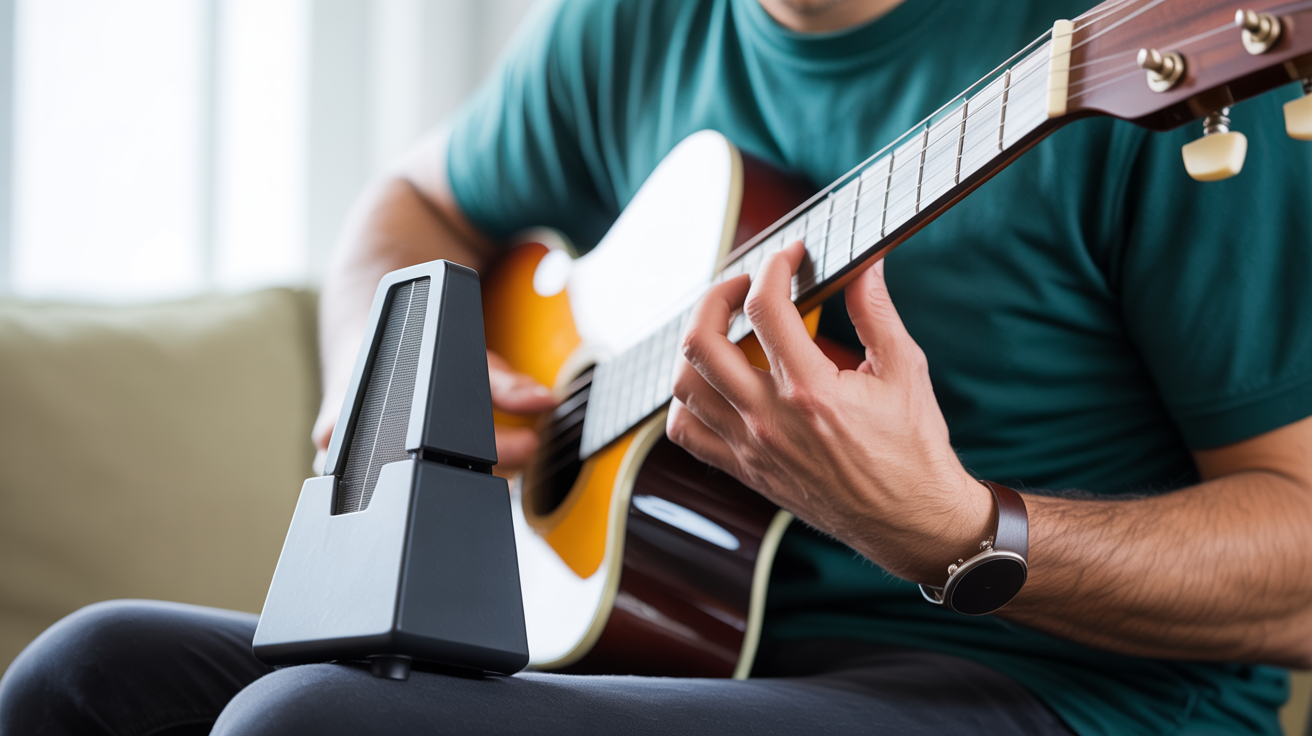
A metronome is the fastest shortcut to better strumming. If you ever feel like you speed up during chord changes or slow down when a pattern gets tricky, a metronome will show you exactly where those problems happen and give you a target to fix them against.
This guide walks you through how to practice guitar with a metronome from the very first click, including what tempo to start on, how to build up speed, and when to push the tempo versus when to stay put.
What a Metronome Actually Does for Your Strumming
A metronome plays a steady beat at a tempo you choose, measured in BPM (beats per minute). Your job is to match your strumming to those beats.
That sounds simple, but it exposes two common beginner problems right away:
- Rushing -- playing slightly ahead of the beat, especially when a chord change is coming up
- Dragging -- slowing down on a chord change because your fretting hand hasn't caught up yet
When you practice without a metronome, your brain fills in the gaps and you don't notice the inconsistency. With a metronome, every beat either lines up or it doesn't. That clarity is uncomfortable at first and genuinely useful for that exact reason.
Choosing a Starting Tempo
The standard beginner mistake is setting the metronome too fast. Start slower than you think you need to.
A practical starting range for most beginners is 50 to 70 BPM. At this tempo, each beat is slow enough that you can hear whether your strum landed on it, slightly before it, or slightly after.
Here is a rough guide:
| Stage | BPM Range | What to focus on |
|---|---|---|
| Learning a new pattern | 40-60 BPM | Accuracy over the beat |
| Getting comfortable | 60-80 BPM | Smooth chord transitions |
| Building speed | 80-100 BPM | Consistency across full patterns |
| Playing songs | 100+ BPM | Musical feel, not just timing |
Do not jump up the tempo until you can play through the pattern cleanly three times in a row at the current one. That rule saves a lot of wasted practice time.
How to Set Up a Metronome Practice Session
You do not need a physical metronome. Free apps like Tempo, Metronome Beats, or simply searching "online metronome" in your browser all work fine.
Step 1: Set the time signature
Most guitar songs are in 4/4 time, meaning four beats per measure. Set your metronome to accent beat one so you can hear where each measure starts. This helps you stay oriented when a strum pattern repeats.
Step 2: Start on one chord
Before you try any chord changes, practice your strum pattern on a single open chord. Put your left hand in a G or Em shape, strum along with the click, and focus entirely on your right hand matching the beat.
Step 3: Add chord changes
Once the strum pattern feels automatic on one chord, bring in a chord change. For basic strumming patterns, a two-chord loop (G to C, or Am to Em) is enough to work with.
Notice where the timing wobbles. It will almost always wobble on the beat just before or just after the chord change. That is the moment to practice in slow motion.
Step 4: Raise the tempo gradually
Increase by 5 BPM at a time. Small jumps let you consolidate what you've built. Jumping 20 BPM at once usually breaks the pattern and sends you back to square one.
Common Mistakes When Using a Metronome
Practicing mistakes at full speed
If you play a wrong strum or a muted chord, stop. Reset to the beginning of the measure and play it again at the same tempo. Practicing through errors at speed just locks in the error.
Only practicing fast
Slow practice is real practice. Playing a pattern at 55 BPM with clean tone and accurate timing builds more usable muscle memory than slogging through at 110 BPM with a mess of missed beats. Return to slow tempos even after you can play something fast.
Ignoring the click between beats
The click lands on beats 1, 2, 3, and 4. The "and" counts fall exactly halfway between clicks. For a basic down-up strumming motion, your up-strums land on those "and" counts. If you only listen for the downbeat clicks, you lose half the timing information the metronome is giving you.
Quitting after one good run
One clean run at a tempo means you got lucky once. Three clean runs in a row means you can actually play it at that tempo. Use the three-run rule before moving up.
Building Your Timing Over Time
Consistent timing does not develop from one long session. It builds from many short ones. Fifteen minutes of focused metronome practice three or four times a week will improve your rhythm faster than a single two-hour grind once a week.
A useful weekly structure:
- Warm up at a familiar, comfortable tempo (one you already own)
- Spend ten minutes on the pattern you're currently developing
- Spend five minutes pushing that pattern five to ten BPM above your current ceiling
- Back off to a comfortable tempo to close the session
This keeps practice sessions feeling productive instead of like a fight.
For a deeper look at how timing connects to strum patterns in practice, the guide on keeping time and strumming in rhythm builds on what you've learned here and covers counting out loud as a parallel technique.
Frequently Asked Questions
Do I need a physical metronome or will an app work?
An app works perfectly well. The click from a phone or computer speaker is identical in function to a physical metronome. If you're practicing somewhere without a speaker, a free metronome app with a headphone jack or wireless earbuds handles it fine. The only real advantage of a physical metronome is that it sits on a music stand without a phone screen glowing at you.
What BPM should a complete beginner start on?
Start at 60 BPM. It's slow enough to hear each beat clearly and gives you time to think about your strum between clicks. If 60 BPM still feels rushed when you add a chord change, drop to 50. There is no prize for starting fast.
My timing is fine when I play along to songs. Why do I still need a metronome?
Songs have a lot of sonic information that masks timing problems: vocals, bass, drums, and production all give your ears cues to latch onto. A metronome removes all of that, leaving only a single click. The problems a song hides, the metronome reveals. Both are useful, and they train slightly different things.
How long before I notice improvement?
Most beginners notice a real difference after two to three weeks of consistent, short sessions. The first sign is that chord changes stop throwing off your strum pattern as much. The second sign is that you start to feel the beat physically rather than just counting it mentally.
Can I use a drum loop instead of a click track?
Yes, and for many players a simple drum loop is more enjoyable. It works the same way as a metronome as long as the loop has a consistent pulse you can sync to. Once you're comfortable with a plain click, switching between the two keeps practice from getting repetitive.