Strumming & Rhythm
How to Add Dynamics: Playing Soft, Loud, and Accents
Learn guitar dynamics for beginners: how to play softer, louder, and add accents to your strumming so your playing sounds musical, not mechanical.
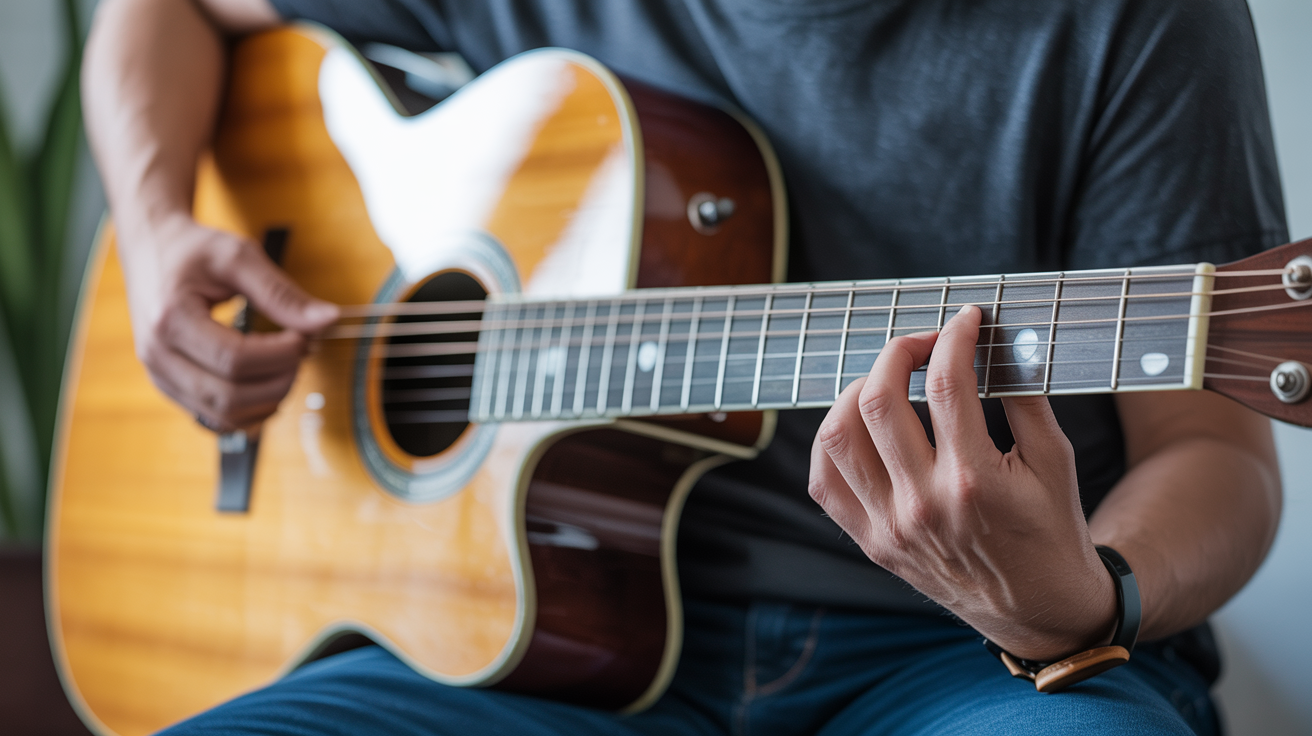
If your strumming sounds like a metronome hitting the same volume on every beat, dynamics are the fix. Guitar dynamics for beginners means controlling how hard or soft you strike the strings on purpose, and using that control to make phrases feel alive. It is one of the most overlooked skills in early practice, yet it costs nothing to learn and pays off immediately.
What Dynamics Actually Mean on Guitar
Dynamics refer to changes in volume and intensity. On guitar, you create them mainly through one thing: how much force your pick or fingers use when they contact the strings.
Strike hard and you get a loud, bright tone. Strike lightly and you get a softer, rounder sound. The pitch stays the same. The rhythm stays the same. Only the energy of the stroke changes.
Two Italian terms show up in sheet music and tutorials:
| Term | What It Means | How Loud |
|---|---|---|
| piano (p) | soft | quiet |
| mezzo-piano (mp) | medium-soft | moderate-quiet |
| mezzo-forte (mf) | medium-loud | moderate-loud |
| forte (f) | loud | loud |
Most songs for beginners sit between mp and mf. Knowing these labels helps you understand written guitar parts and communicate with other musicians.
Why Strumming Dynamics Matter
A song played at a single volume sounds flat. Verses often call for softer strumming to leave room for the melody to come through. Choruses usually call for more energy and a fuller stroke. Bridges can go either direction.
Strumming dynamics also help you:
- Stay in control when playing with a singer (too loud drowns them out)
- Signal structural changes in a song without stopping
- Make a simple two-chord progression feel interesting
Once you understand how to strum a guitar with the basic down-up motion, dynamics are the next layer that turns that motion into real music.
How to Play Softer on Guitar
Playing softer on guitar feels counterintuitive at first because you have to relax your grip rather than tighten it. Here is a simple exercise:
- Hold your pick loosely, almost at the tip, letting it flex as it brushes across the strings.
- Keep your wrist relaxed and let the pick skim the surface rather than dig in.
- Aim the pick so only a small portion of it actually contacts the strings.
- Think of brushing dust off the strings rather than striking them.
You do not need to reduce the size of your strumming arc. The arc can stay the same. The contact point is what changes.
Practice on a single open chord. Strum four downstrokes at full volume, then four at half volume, then four as quietly as you can while still making clean sound. Loop through that without stopping. You will notice your hand wanting to tense up when you go quiet. Resist that. Soft playing needs a looser hand, not a tighter one.
Using Your Thumb Instead of a Pick
For an even softer sound, switch to your thumb on downstrokes. The fleshy pad of the thumb dampens the attack and creates a warm, round tone well below what a pick can achieve. This is useful for quiet fingerpicking intros or acoustic ballads where a pick feels too sharp.
How to Add Accents to Your Strumming
An accent is a single strum hit harder than the strums around it. Accents in strumming create rhythmic punch and groove. They are the difference between strumming that keeps time and strumming that feels like a song.
The most common accent position is beat 2 and beat 4 in a 4/4 bar. That is the backbeat, and it is what gives rock, pop, and folk strumming its drive.
Try this on any chord you know:
Beat:  1   2   3   4
Strum: D   D   D   D
Dyn:   mp  mf  mp  mf
Beat 1 and 3 are softer. Beat 2 and 4 land with a bit more weight. You do not need to strum physically harder in a dramatic way. A 20 percent increase in force is enough to hear the difference.
Once that feels stable, try putting the accent on the upstrokes in a pattern. Many standard strumming patterns already have natural accent points built in. Identifying where those are and exaggerating them slightly is how you make a pattern feel authentic rather than mechanical.
Accent Exercise: The Loud-Soft-Loud Drill
Play a simple down-up pattern across four beats. On the first strum of each pair, hit harder. On the second, back off. Alternate back and forth for two minutes without stopping.
This trains your arm to vary intensity mid-pattern, which is exactly what live playing requires. When you can do this without thinking about it, you can apply accents anywhere in a pattern on demand.
Combining Soft and Loud Within a Song
The real payoff comes from using dynamics across a full song structure. Here is a simple approach:
Verse: Play at mp. Keep strums light, let the vocal breathe.
Pre-chorus: Bump to mf. A little more energy, building expectation.
Chorus: Go to f. Full stroke, all strings, accent the backbeat.
Bridge: Drop back to mp or even quieter, then build again before the final chorus.
You do not have to plan this out chord by chord. Pick a target volume for each section and let your arm adjust. After a few run-throughs it becomes automatic.
This approach works with any song structure. It also makes you a much more useful rhythm player if you are ever playing with another guitarist, a singer, or a small band. Being able to pull back when someone else is soloing or singing a quiet phrase is a real skill, and it starts here.
To make these dynamics feel natural, you need steady time underneath them. Reviewing how to keep time and strum in rhythm alongside this practice helps the two skills reinforce each other.
A Simple 10-Minute Dynamics Practice Routine
| Minute | Exercise |
|---|---|
| 1-2 | Soft-medium-loud drill: four strums at each level, cycling up and down |
| 3-4 | Backbeat accent on a simple down pattern |
| 5-7 | Play a song or chord progression, applying a soft verse / loud chorus structure |
| 8-10 | Record yourself on your phone and listen back for the contrast |
The recording step matters. Your ear adjusts when you are playing, and what feels like a big dynamic difference often sounds smaller on playback. Listening back tells you the truth.
Frequently Asked Questions
Does using a thinner pick help me play softer?
A thinner pick flexes more on contact and does produce a slightly softer sound. But pick thickness is not the main variable. Your stroke force and angle matter more. You can play very softly with a heavy pick and very loudly with a thin one. Start by controlling your arm and save pick experiments for after you have some feel for the technique.
I keep accidentally muting strings when I try to strum quietly. What am I doing wrong?
You are probably slowing your strum speed as well as reducing force. Keep your wrist moving at the same speed as usual, but lighten the contact. If your wrist slows down to compensate, the pick drags across the strings and mutes them. Speed stays constant; force is what changes.
How do I know which beats to accent in a song I am learning?
Listen to a recording of the song and tap your foot or hand along with it. The beats that feel natural to tap hardest on are usually where the accents fall. In most Western pop and rock, that is beats 2 and 4. Once you identify them by ear, apply the same accent on guitar.
Will dynamics become automatic or do I always have to think about them?
With deliberate practice, dynamics do become mostly automatic. Spend a few weeks consciously applying them to everything you play, and your arm starts to do it without conscious effort. The goal is to internalize the feel of different stroke weights so they are available to you without thinking.
Do dynamics apply to fingerpicking as well as strumming?
Yes. In fingerpicking, dynamics come from how hard individual fingers pluck each string. You can bring out a melody note by plucking that string slightly harder than the accompaniment notes around it. The concept is identical; only the technique differs.