Songs & Playing
How to Use a Capo to Match a Song to Your Voice
Learn how to use a capo to change key and match any song to your voice. Step-by-step guide for beginners on transposing with a capo while keeping the same ch...

A capo is a small clamp that attaches to your guitar neck and raises the pitch of every string at once. Clip it to the second fret and the whole guitar sounds a whole step higher. Move it to the fifth fret and you have raised the pitch even further, all without changing a single chord shape you already know. That is the core idea: you keep playing the same fingering patterns, and the capo does the work of shifting the key up to fit your voice.
At a Glance
- A capo clamps across all six strings at once, acting like a movable nut and raising every open string's pitch.
- Each fret you move the capo up raises the key by one semitone (half step).
- Your chord shapes stay exactly the same. Only the sounding pitch changes.
- Find your key by trial: play and sing in the original key, then move the capo up one fret at a time until the melody sits comfortably.
- Position the capo close to the fret wire, straight across the neck, and check every string for buzz after clamping.
- If a song needs a lower key than open position allows, tune down or use different chord shapes instead of relying on the capo alone.
What a Capo Actually Does
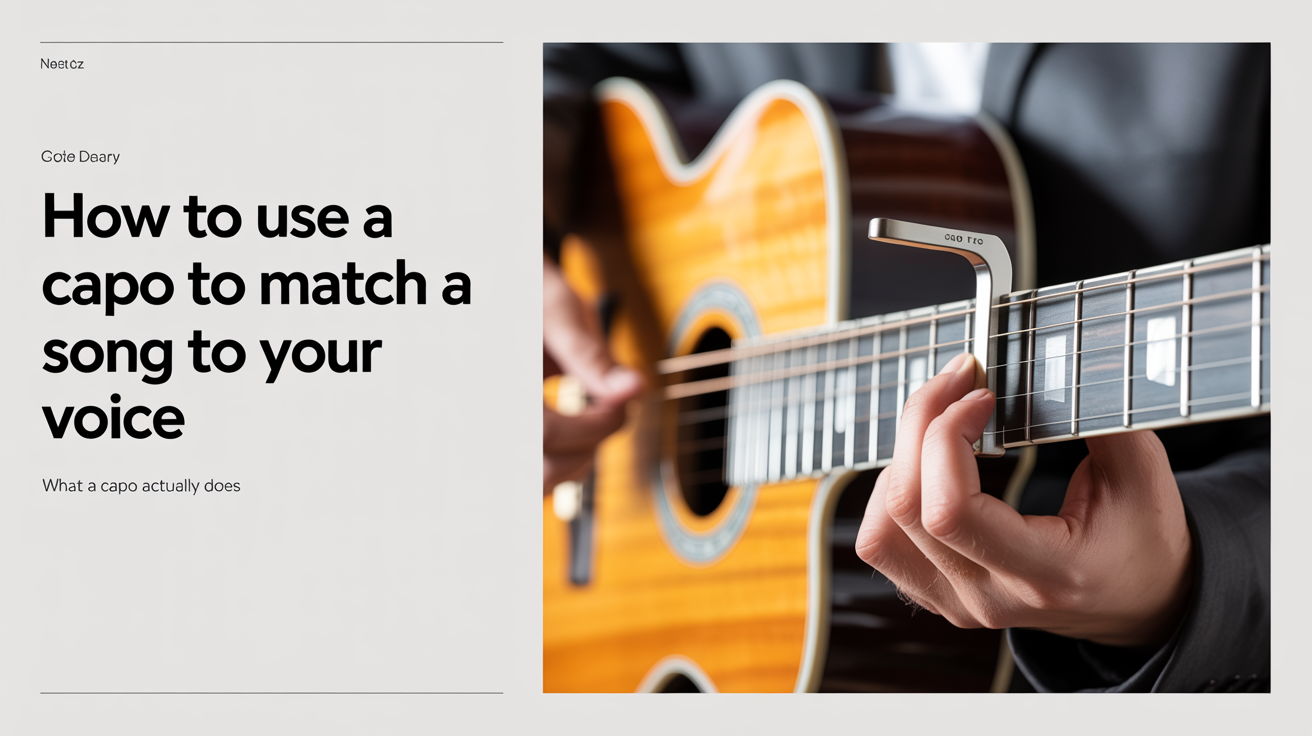
When you press the capo onto a fret, it acts like a new nut at that position. Every open string now rings at the pitch it would if you were fretting that note with your finger. The rest of the guitar below the capo is muted, so you only play the strings above it. A capo is defined simply as a device attached to the frets of a string instrument to raise the pitch of each string uniformly, which is exactly this mechanism: one clamp, one new effective nut position, every string shifted by the same amount.
The result is that chord shapes translate directly. If you know a G chord shape, putting the capo on the second fret and playing that same G shape gives you an A chord in actual pitch. The chord shape feels identical to you, but the sound has shifted up.
This is how singers and guitarists have always matched songs to their voices without learning brand-new chord fingerings for every key. In music theory terms, what the capo is doing is transposition, moving every note in a piece up or down by the same fixed interval while keeping the relationships between the notes identical. A capo just performs that transposition mechanically instead of you having to recalculate new fingerings by hand.
How to Use a Capo to Match a Song to Your Voice
The process takes a few minutes and is straightforward to repeat whenever you find a song that sits outside your comfortable range.
Step 1: Find the original key
Look up a chord chart or tutorial for the song. The chords listed usually reflect the original recorded key. A quick search for "[song name] guitar chords" will get you there fast.
Step 2: Try singing along in the original key
Play through the opening section and sing the melody. Notice where your voice feels most natural. If the notes feel too high and you are straining to reach them, you need a lower key. If the notes feel too low and your voice sounds thin or muddy, you need a higher key.
Step 3: Move the capo up one fret at a time
Each fret raises the key by one semitone (one half step), the smallest interval used in Western music and the same unit that separates every adjacent pair of frets on the neck. Move the capo up one fret, play the same chord shapes, and sing again. Keep going until the melody sits in a range where your voice sounds comfortable and full.
If you need a lower key instead of higher, you have two options: use a different set of chord shapes that puts the song in a lower key (sometimes listed as an alternate version online), or tune your guitar down a half step and use the capo to fine-tune from there.
Step 4: Lock in the position and play
Once you find the capo position that works for your voice, lock in the clamp, check that every string rings clearly (press each one and make sure there is no buzzing), and play through the song.
You are now using a capo to match your voice to a song, and you only had to learn the original chord shapes.
A Capo Reference Chart for Common Keys
The table below shows how your open chord shapes translate when you put the capo on different frets. The chords in the left column are what your fingers play; the columns show what pitch those shapes produce at each capo position.
| Your Finger Shape | Capo 1 | Capo 2 | Capo 3 | Capo 4 | Capo 5 |
|---|---|---|---|---|---|
| G | Ab | A | Bb | B | C |
| C | Db | D | Eb | E | F |
| D | Eb | E | F | Gb | G |
| Em | Fm | F#m | Gm | Abm | Am |
| Am | Bbm | Bm | Cm | Dbm | Dm |
| A | Bb | B | C | Db | D |
So if a song is in the key of B and you do not want to deal with a B chord, you can put the capo on the second fret and play your familiar A-shape chord forms. The guitar will sound in B while your hand plays the A-shape patterns.
Many easy guitar songs for beginners are written specifically because they work well with a capo at frets 2, 3, or 5.
Worked Example: Finding Your Key by Ear
Say you're trying to sing along to a song written in the key of D, using open D, G, and A shapes. You try singing the chorus and your voice cracks on the highest notes; it's too high for you. You move the capo to fret 1 and play the same D, G, and A shapes. The song now sounds in Eb, which is even higher, the wrong direction. So instead you switch strategy: you look up the song played from a C-shape chart (C, F, G), which sits a whole step lower than the D-shape version at no capo. From there you try the capo at fret 1 with the C shapes, landing you at Db, close to the original key but a half step down. One more adjustment, moving to open C shapes with no capo, drops you a full step below the original recording, which turns out to be the sweet spot for your range. The lesson: if adding capo moves you the wrong direction, you need a lower starting chord shape, not a higher capo position.
Tips for Getting the Best Sound With a Capo
A badly placed capo causes buzzing or muted strings. A few habits keep things clean:
Position the capo close to the fret. Place it just behind the metal fret bar, not in the middle of the space between frets. The closer to the fret, the less pressure you need to get a clean ring.
Check every string after clamping. Pluck each string individually and listen for buzz or a deadened tone. Adjust the capo slightly if any string sounds off.
Keep the capo straight across the neck. A crooked capo applies uneven pressure and can pull some strings slightly sharp while leaving others sounding flat.
Use a clip-style spring capo for speed. Spring-loaded capos (like the Kyser style) clip on and off in one hand while the other holds the guitar. Screw-type capos are more adjustable but slower to move mid-song.
When you finish playing, take the capo off and store it clipped to the headstock or in your case. Leaving it clamped on the neck for days can put unnecessary pressure on the strings and nut.
Singing and Playing Guitar With a Capo
If you are still building coordination between your fretting hand and your voice, using a capo to simplify your chord situation can help. A song that originally requires Bb, Eb, and F chords becomes Bb-free if you put the capo on the first fret and play A, D, and E shapes instead. The simpler shapes free up mental bandwidth for singing.
Once you are comfortable learning a song from start to finish, the capo becomes one of the most practical tools in your playing kit. It lets you adapt almost any song to your current chord vocabulary.
One thing to be aware of: the higher you go with the capo, the shorter the scale length becomes between the capo and the nut end of the frets above it. Above the seventh fret, the notes pack together tightly and some chord voicings start to sound a little thin. Most players find the sweet spot between capo 1 and capo 7.
Frequently Asked Questions
Does using a capo make the guitar easier to play? In some ways, yes. A capo shortens the vibrating string length, which can reduce string tension slightly and make the strings feel a little easier to press. On a guitar with high action, this effect is more noticeable. That said, the capo does not eliminate the need to develop clean fretting technique.
Can I figure out where to put the capo just by ear? Absolutely. Move the capo up one fret at a time, sing the melody over your chord shapes, and stop when it feels natural. You do not need to know anything about music theory to find the right position. If you want a starting point, a key finder app or a chord chart that lists the song's key can save you a few minutes of searching.
Do all guitars work with a capo? Any standard six-string acoustic or electric guitar works with a standard capo. Classical guitars have a wider, flatter neck, so they need a capo designed for nylon-string instruments. Twelve-string guitars and bass guitars need their own capo styles as well. For a regular beginner acoustic or electric, any spring-clip capo will do the job.
Will the capo change how I read tabs? Tabs are written relative to finger position, not absolute pitch. So if a tab says to play at the second fret on the high E string, you play the second fret above the capo, not the second fret from the nut. Once you understand that tabs reference your hand position rather than the physical frets on the neck, reading them with a capo is straightforward. If you are new to reading tabs, the guide on how to read guitar tabs for beginners covers this in detail.
What if the song is still too high even without the capo? If the song sits too high even with no capo, and moving to a different chord arrangement makes the chord shapes impractical, you can tune your guitar down. Dropping every string by one or two semitones (called a half-step or whole-step down tuning) lowers the pitch of every open string. You can then use the capo to fine-tune from there, or just play with the guitar tuned down. Some songs are commonly played in drop or down tunings for exactly this reason.
Why do some songs sound thin or jangly with a capo high up the neck? Above roughly the seventh fret, the remaining string length between the capo and the bridge gets short enough that the strings lose some of the low-end resonance a full-length open chord has. The notes are still correct, but the tone can feel thinner or more compressed. If a chart calls for a high capo position and the result sounds too thin for your taste, try the alternate approach of playing the song in a different chord shape closer to open position instead.
Is it okay to leave a capo clamped on the guitar between practice sessions? It's better not to. A capo left on for hours or days applies continuous pressure to the strings and nut area, and over a long enough time that can affect intonation or leave the strings slightly more prone to fatigue at that spot. Clip it to the headstock or store it in your case when you're done playing.