Songs & Playing
How to Slow Down a Song to Learn It on Guitar
Learn how slowing a track to 60-70% speed helps you nail chord transitions and picking patterns, plus the best free tools to do it without losing pitch.
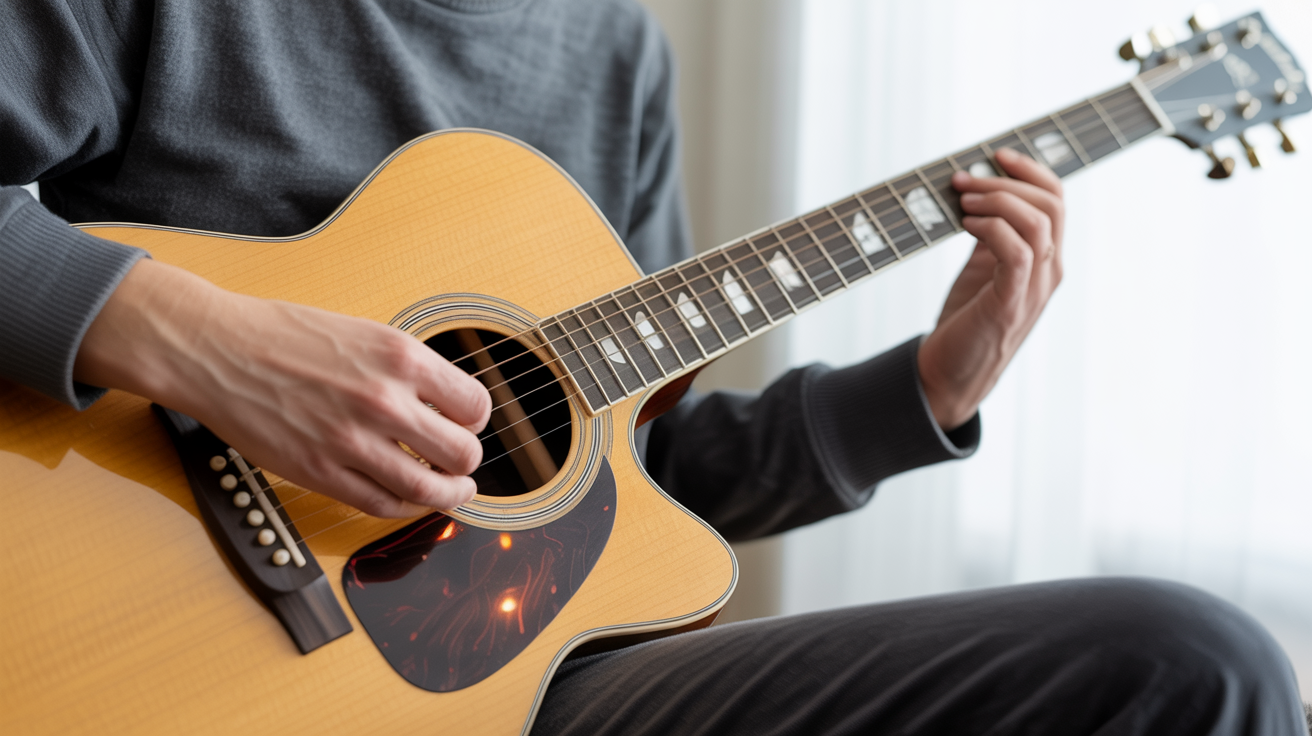
Most beginners hit the same wall: they find a song they love, press play, and the original recording blows right past them. The chord changes come before their fingers move, the picking pattern is a blur, and after a few frustrating loops they give up on that song entirely.
The fix is almost embarrassingly simple. Slow the track down to somewhere between 60 and 70 percent of normal speed and suddenly you can hear every note, watch your fretting hand find each chord, and actually play along without panicking. This single technique is how countless players have learned songs that initially seemed out of reach, and it works whether you are trying to figure something out by ear or just following along with a chord sheet.
Why Slowing Down Works
Your fingers need time to form a new shape, release it, and move to the next one cleanly. At full speed there is no time for any of that. Your brain registers "chord change coming" but the signal from brain to fingers arrives too late, and you either miss the chord or mash down something approximate and hope for the best.
At 65 percent speed, two things happen. First, there is genuine time for a clean transition. Second, you can hear each note in a chord individually, which tells you immediately if one string is muted or buzzing. That feedback loop teaches your hand more in five minutes than an hour of playing slop at full tempo ever could.
The other thing slowing down does is reduce anxiety. When a song feels fast, players tense up. Tight shoulders, a gripped pick, fingers that press too hard. Tension is the enemy of fast playing. Paradoxically, getting comfortable at a slow tempo is what eventually allows you to play fast.
The Best Tools for Slowing Music Down
You do not need to pay for anything to get started. Here are four options, from completely free to a modest one-time purchase.
YouTube speed control is built right into the player. Click the gear icon on any YouTube video, choose Speed, and you can drop to 0.75 or 0.5. That covers most situations. The pitch stays correct, not chipmunk-high or drone-low, because YouTube applies pitch compensation automatically. The limitation is that you cannot fine-tune to something like 65% or loop a specific four-bar section without third-party browser extensions.
Amazing Slow Downer (iOS and Android) lets you load any audio file from your device and dial tempo from 25 to 200 percent in one-percent steps while keeping pitch locked. It also has A/B loop points so you can set the exact passage you want to repeat and it cycles there automatically. There is a free version with some limits; the full unlock is a few dollars.
Transcribe! (Mac, Windows, Linux) is the tool of choice for serious transcription work. You can slow to any percentage, set loops, detect chord changes automatically, and annotate a timeline. It costs around $39 as a one-time purchase with no subscription. Overkill for casual learning but worth it if you spend a lot of time learning songs by ear.
Soundslice is browser-based and built around synchronized notation and tablature. Many teachers publish guitar lessons directly on the platform, and learners can slow those lessons down, loop sections, and toggle between score and audio. A free tier exists, and certain content is free; premium content requires a subscription.
For most beginners, YouTube's speed control and Amazing Slow Downer cover everything. Start with YouTube since it costs nothing and you can use it immediately.
The Practice Loop: How to Actually Use Slow Speed
Having a slow-speed tool is one thing. Knowing how to structure your practice with it is what turns tool access into real progress. Here is the loop that works.
Step 1: Isolate the hard passage. Do not try to slow down the whole song at once and play along start to finish. Find the eight or sixteen bars that stump you. Maybe it is a fast chord change from G to Bm. Maybe it is a fingerpicking pattern in the verse. Identify that section and work it in isolation.
Step 2: Set tempo to 60 percent. Play along. The goal here is zero mistakes. If you are still fumbling at 60 percent, drop to 50. There is no shame in 50 percent. The point is to establish what a clean repetition feels like.
Step 3: Repeat the clean version five times in a row. Not four, not three. Five consecutive clean repetitions. Your hands are building muscle memory with each one. A single clean rep followed by two sloppy ones mostly reinforces sloppiness. You need the clean pattern stacked on itself.
Step 4: Bump tempo by 5 percent. Go to 65 percent and repeat the five-clean-reps target. If you lose it at 65, drop back to 60 and do two more clean passes before trying again.
Step 5: Keep climbing in 5-percent steps. 70, 75, 80, 85, 90, 95, 100. At each step you either nail five clean reps and move up, or you drop back one step and consolidate. Do not rush the climb. Going from 80 to 90 and immediately scrambling teaches nothing. A patient 5-percent step takes maybe an extra ten minutes and saves you two weeks of frustration.
One session of this loop on a single difficult passage will often get you to 85 or 90 percent. The final jump to 100 sometimes takes a second session after sleeping on it. That is normal. Sleep consolidates motor memory in a way that more practice in the same day does not.
For a broader look at how to tackle a song from beginning to end, see how to learn a song on guitar from start to finish. And for building this kind of slow-practice habit into a regular schedule, how to build a daily guitar practice routine that works covers how to structure your time so focused work like this actually happens consistently.
Connecting Slow Practice to Playing in Time
There is one trap beginners fall into with slow-speed practice: they get clean at slow tempo but cannot play in time when the track returns to full speed. The reason is usually that slow practice allowed a lot of subtle timing drift that did not matter at 60 percent but falls apart at 100.
The safeguard is simple. Even at slow speeds, play to a fixed pulse. If you are using Amazing Slow Downer or Transcribe!, the original track is still providing a beat at reduced tempo. Play to that beat. If you are working with a metronome instead of a slowed track, set it to match 60 percent of the song's actual BPM. For a song at 120 BPM, 60 percent is 72 BPM.
This habit means that when you bring tempo back up, the underlying timing structure in your playing is already there. You are not relearning the rhythm from scratch at full speed.
Once you are comfortable playing a passage cleanly at 100 percent tempo with the slowed track, try playing along with the original recording without any speed adjustment. That is the real test. If anything falls apart, you know exactly what to slow back down and which passage needs more five-clean-reps work.
For more on staying locked to a beat while playing along with recordings, see how to play along with songs in time.
Frequently Asked Questions
How slow should I go when first learning a song? Start at 60 to 65 percent and adjust from there. If you are still making mistakes at 60 percent, drop to 50. The right starting speed is whatever lets you play the passage cleanly. There is no tempo too slow for the first pass.
Does slowing down a song change the pitch? Modern tools like YouTube's speed control, Amazing Slow Downer, and Transcribe! use pitch-shifting algorithms that preserve the original key when you change tempo. The song will sound exactly as it should, just slower. Older methods like simply slowing down a tape or vinyl did lower pitch, but those are not how digital tools work today.
How long does it take to get a hard passage up to full speed? It varies a lot depending on difficulty and how much time you put in. A moderately tricky chord change might reach full speed in a single 20-minute session. A fast fingerpicking pattern could take several sessions spread across a week. The 5-percent increment method gives you a reliable way to track progress regardless of how many sessions it takes.
Can I use this method to learn songs by ear? Yes, and slowing down is especially useful for ear training. At 60 or 65 percent you can hear individual notes in a chord voicing, follow a bass line, or catch a quick ornament that is invisible at full speed. Slow it down until you can identify what you are hearing, figure out where it sits on the fretboard, then bring it back up to speed.
Do I always need to reach 100 percent before moving on? Not necessarily. If the original recording is at the absolute edge of your current ability, it is fine to master a section at 90 percent and return to the song in a few weeks once your technique has developed. The goal is clean, repeatable playing, not forcing a tempo your hands are not ready for yet.