Chords & Theory
Beginner Guitar Theory: The Notes on the Fretboard
Learn the notes on the guitar fretboard with simple patterns and memory tricks. A beginner's guide to reading, memorizing, and navigating the neck.
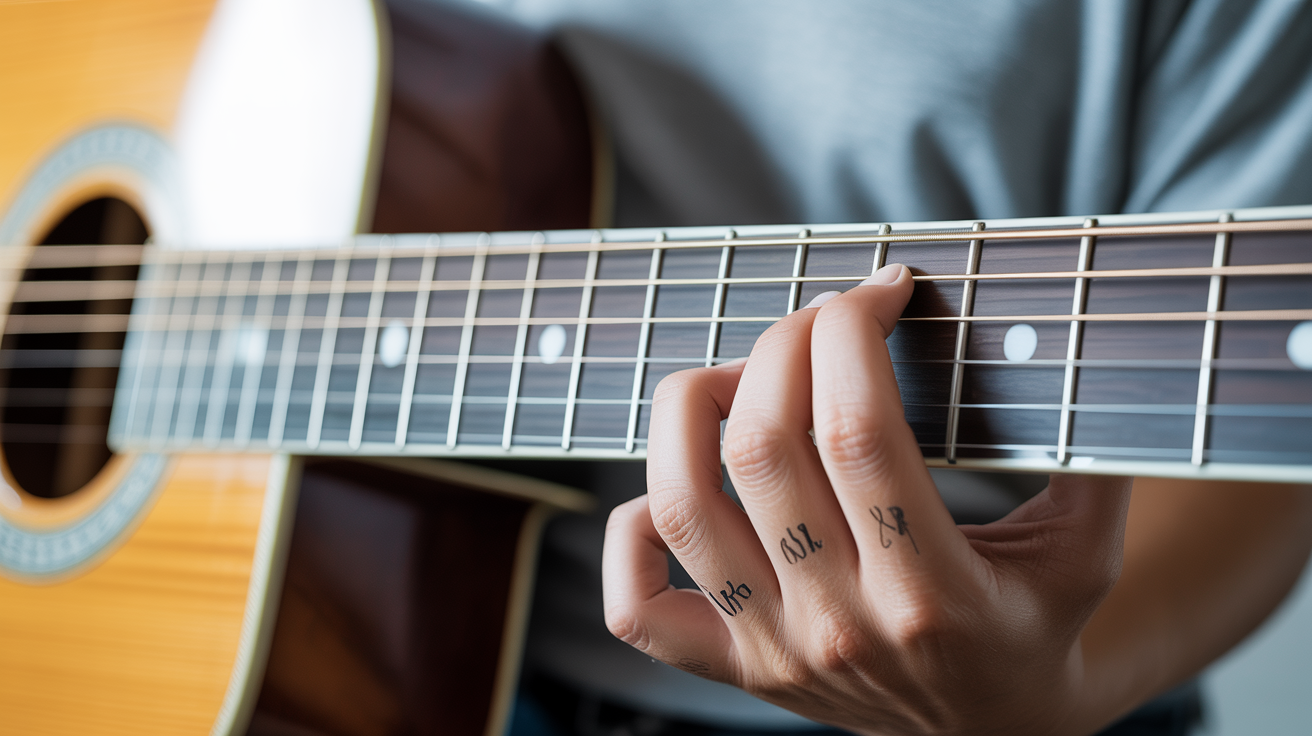
Knowing the notes on the guitar fretboard is one of the most useful skills a beginner can build. It lets you find chord shapes anywhere on the neck, communicate with other players, and understand what you're actually playing. The good news: you don't need to memorize all 144 dots at once. A handful of patterns get you most of the way there.
The Musical Alphabet and How the Fretboard Works
There are only 12 unique notes in Western music. The natural notes are A, B, C, D, E, F, and G. Between most of them sits a sharp (or flat) note, which gives you the full chromatic scale:
A A# B C C# D D# E F F# G G# (then back to A)
Two gaps have no sharp between them: B to C, and E to F. Those two pairs sit directly next to each other with no in-between note.
On the guitar, each fret raises the pitch by one half-step. So if you know one note, you can count up the chromatic scale to find any other note on that same string. The open strings on a standard-tuned guitar are:
String 6 (thickest): E
String 5:            A
String 4:            D
String 3:            G
String 2:            B
String 1 (thinnest): E
A useful memory phrase for the open strings from low to high: Every Angry Dog Gets Bitten Eventually.
Why Learning the Fretboard Matters
You might wonder whether this is worth the effort when you could just learn chord shapes and patterns. Fair question. Here is what changes once you know the notes:
- You can find the same chord in multiple positions up the neck, which keeps your fretting hand from traveling long distances.
- You understand why a chord is named what it is, which makes reading a guitar chord chart much less mysterious.
- You can talk to other players. If a bandmate says "hit a G at the third fret," you know exactly what they mean.
- When you hit a buzzy or muted note, you know which specific note is the problem, not just that something sounds off.
None of this requires you to know every note on day one. Even knowing the notes on two strings opens up a lot.
Start With the 6th and 5th Strings
The two thickest strings are where most chord roots live. Learn these notes first and you'll be able to name root notes for the first chords every beginner should learn.
Here are the natural notes up the 6th string (low E):
Fret:  0   1   2   3   4   5   6   7   8   9   10  11  12
Note:  E   F   F#  G   G#  A   A#  B   C   C#  D   D#  E
And on the 5th string (A):
Fret:  0   1   2   3   4   5   6   7   8   9   10  11  12
Note:  A   A#  B   C   C#  D   D#  E   F   F#  G   G#  A
Notice that fret 12 is always the same note as the open string, just one octave higher. That gives you a built-in reset point.
A practical drill: pick one string and say the note name out loud as you play each fret from 0 to 12, then back down. Do this for five minutes a day with just the 6th string for a week, then add the 5th string the next week.
Octave Shapes: A Shortcut for Finding Notes
You don't have to memorize every string separately. The fretboard has repeating octave shapes, which let you find the same note on a different string without counting from scratch.
The most useful shape: if you know a note on the 6th string, the same note on the 4th string sits two frets higher.
6th string, fret 3 = G
4th string, fret 5 = G  (same note, higher octave)
A second shape: a note on the 5th string also appears on the 3rd string two frets higher.
5th string, fret 3 = C
3rd string, fret 5 = C
These shapes hold all the way up the neck. Once you know a note on one string, you can locate it on another in seconds. This is much faster than memorizing each string from scratch.
A Simple Table of Notes at Every Fret
The table below shows the natural notes (no sharps/flats) for each open string up to fret 12. The sharp note between any two naturals sits one fret above the lower note.
| Fret | String 6 (E) | String 5 (A) | String 4 (D) | String 3 (G) | String 2 (B) | String 1 (E) |
|---|---|---|---|---|---|---|
| 0 | E | A | D | G | B | E |
| 2 | F# | B | E | A | C# | F# |
| 3 | G | C | F | A# | D | G |
| 5 | A | D | G | C | E | A |
| 7 | B | E | A | D | F# | B |
| 8 | C | F | A# | D# | G | C |
| 10 | D | G | C | F | A | D |
| 12 | E | A | D | G | B | E |
Use this as a reference while you practice, then gradually work on recalling notes without looking.
How to Memorize the Fretboard Over Time
The key is small, consistent sessions rather than marathon cramming. Here are four methods that actually work for beginners:
Say it out loud. When you play a note, name it. Connecting the sound, the physical position, and the word "G" (for example) builds memory faster than silent finger movements.
Use landmark notes. Certain notes are easy to find because of the fret markers. Most guitars have dots at frets 3, 5, 7, 9, and 12. Pick one landmark per practice session. Today: fret 5 on every string. Say each note, play it, repeat.
Learn one string per week. Start with the 6th string. Week two: 5th string. By week six you'll have the whole neck covered at a comfortable pace.
Play scales slowly. The open-position major scale on a single string forces you to say each note in order. Once you can do that for one key without hesitation, you're internalizing the note sequence rather than just the finger pattern. Pair this with clean fretting technique so each note actually sounds clear as you go.
There is no trick that replaces the reps. But the reps do not take long per session. Five minutes of deliberate, out-loud note naming each day moves faster than an hour of mindless noodling.
Frequently Asked Questions
Do I need to know the fretboard before learning chords? No. You can learn open chords by shape from day one. Knowing the fretboard is something you build in parallel over your first few months. Start the note-naming drills whenever you feel ready, even if you're still working on your first few chord changes.
What is the fastest way to memorize the fretboard? The octave-shape method gets you the most mileage earliest. Learn the natural notes on the 6th string first, then use the two-fret octave shape to find the same note on the 4th string. That single pattern covers a lot of the neck without brute-force memorization.
How long does it take to know all the notes? Most beginners who practice for five minutes a day can name any note on the 6th and 5th strings within two to three weeks. Knowing every note on every string fluently typically takes two to four months of steady, daily practice.
What is the difference between a sharp and a flat? A sharp raises a note by one half-step; a flat lowers it by one half-step. F# and Gb are the same pitch. On the fretboard you will see both names depending on the key you are playing in, but the fret position is identical.
Do I need to memorize the fretboard to play songs? Not to play your first songs, no. Chord shapes and strumming patterns will take you a long way before fretboard knowledge becomes essential. But knowing even the 5th and 6th string notes will help you find chord shapes faster and understand what your practice is building toward.